Deposit Profile
Primary Commodity:
Copper (Cu)
Associated Commodities:
Gold (Au), locally Silver (Ag)
Deposit Type:
Volcanogenic Massive Sulphide (VMS)
Stockwork and vein-hosted sulphide systems
Host Rocks:
Basaltic to andesitic volcanic rocks, volcaniclastic units, sheeted dyke complexes
Tectonic Setting:
Oceanic crust / supra-subduction zone environment within the Oman Ophiolite
Ore Minerals:
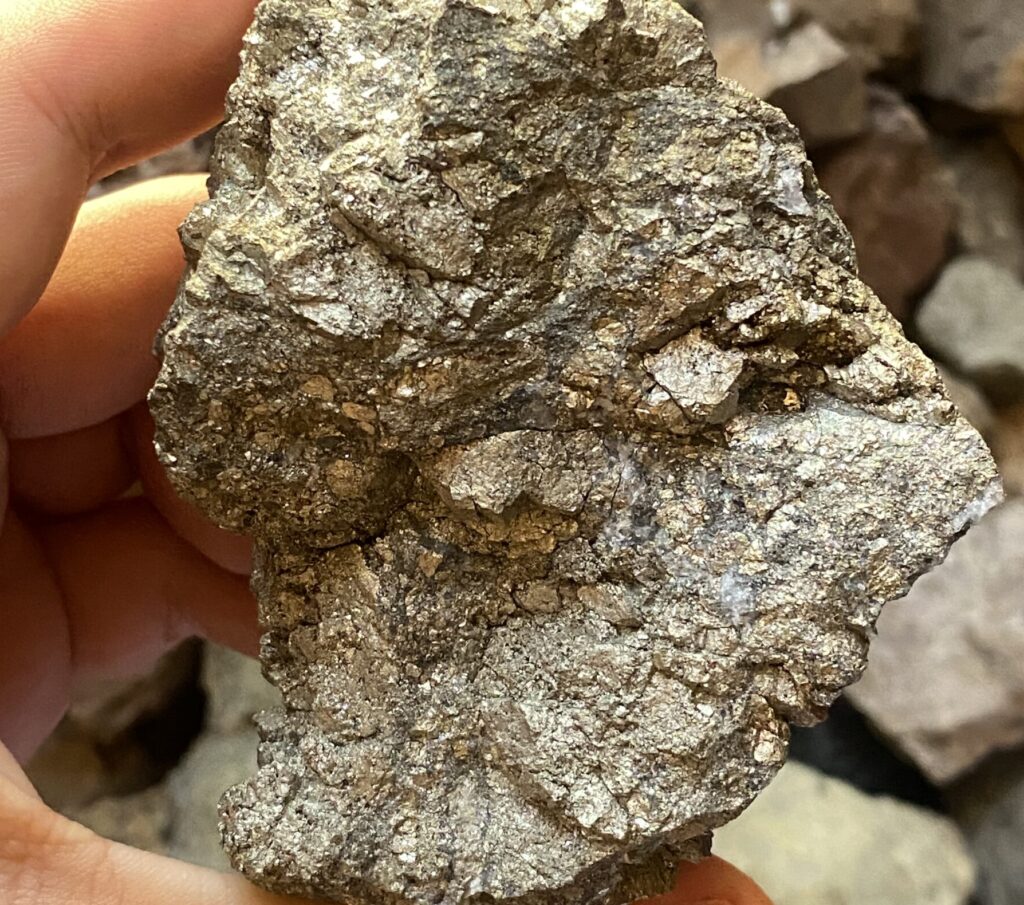
Chalcopyrite, pyrite, locally bornite; minor sphalerite and pyrrhotite
Gangue Minerals:
Quartz, chlorite, epidote, calcite
Alteration Style:
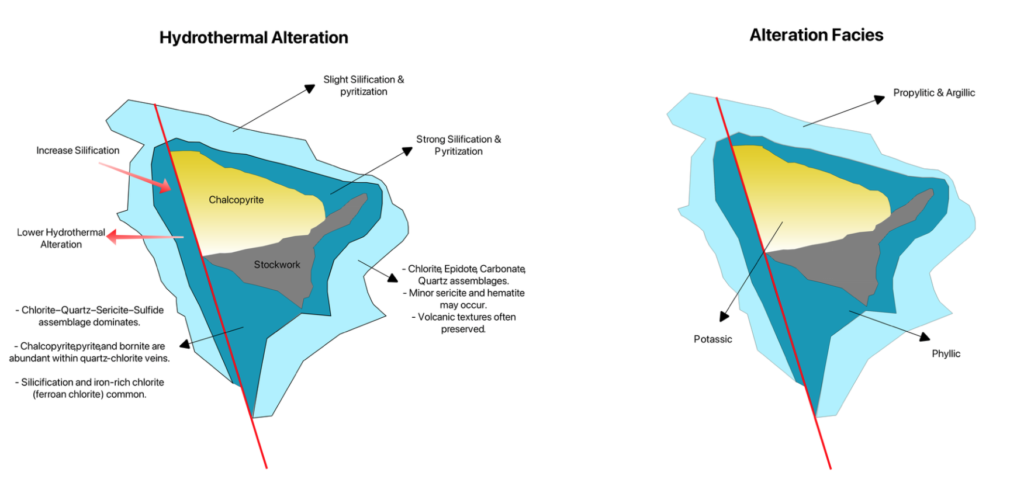
Chloritic, silicic, sericitic; locally carbonate alteration
Structural Controls:
NW–SE and NE–SW trending faults and shear zones; feeder zones and fracture networks
Mineralization Style:
Massive sulphide, semi-massive sulphide, stockwork and disseminated sulphides
Typical Grades:
Copper: ~0.6–2.5% Cu
Gold: ~0.3–2.0 g/t Au
Deposit Scale:
Small to medium-sized deposits; district-scale mineralized belts
Exploration Status:
Historical mining, active and advanced exploration in multiple belts
Geological Setting
Copper/gold mineralization in Oman is genetically linked to the volcanic and upper crustal sections of the Oman Ophiolite, one of the most complete and well-preserved ophiolite complexes in the world. The ophiolite represents fragments of Late Cretaceous oceanic lithosphere that were obducted onto the Arabian continental margin. It preserves a full oceanic sequence including mantle peridotites, layered gabbros, sheeted dyke complexes, and submarine volcanic rocks.
Tectonic Setting
The copper/gold deposits formed in a supra-subduction zone (SSZ) oceanic environment, where oceanic crust developed above a subducting slab. This tectonic setting promoted intense magmatism, hydrothermal circulation, and metal enrichment. Most deposits are classified as Volcanogenic Massive Sulphide (VMS) systems, formed at or near the seafloor by hydrothermal processes associated with submarine volcanism. Mineralization is primarily hosted within basaltic to andesitic volcanic rocks, volcaniclastic units, and locally within sheeted dyke complexes. These rocks belong mainly to the volcanic sequences of the ophiolite, where hydrothermal convection systems were active during oceanic crust formation.
Deposit Formation Process
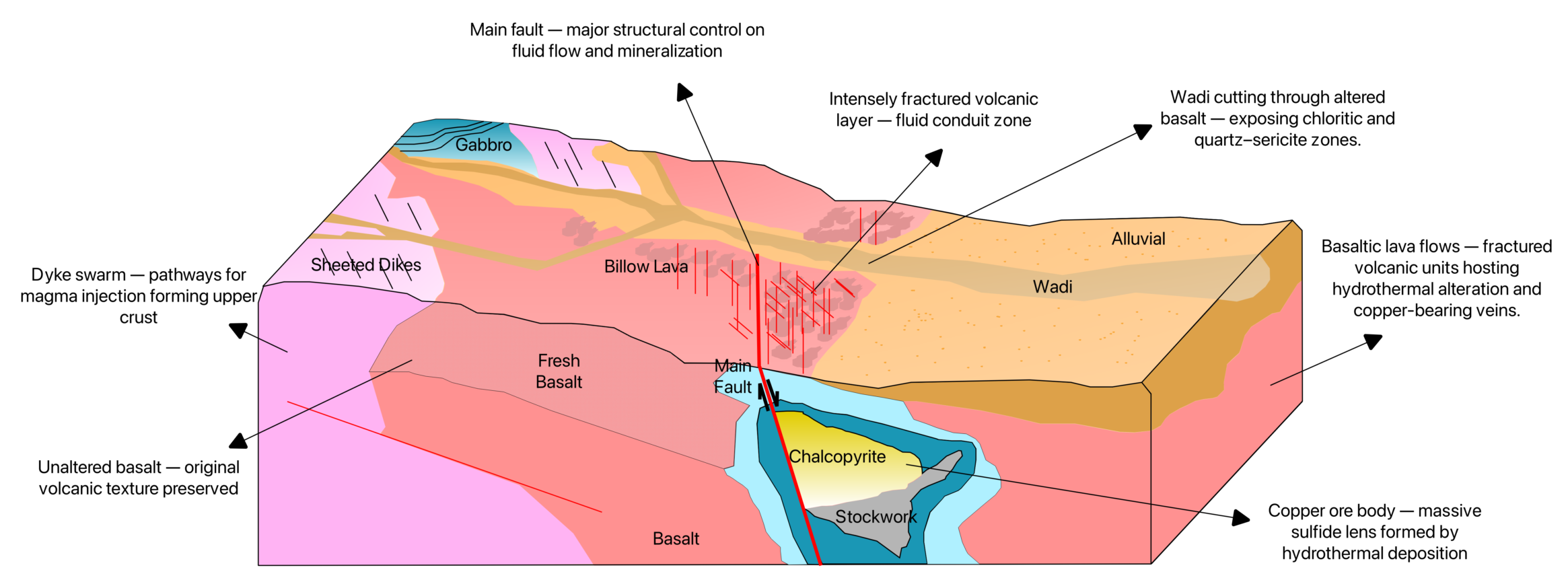
Copper/gold mineralization developed through submarine hydrothermal circulation systems driven by magmatic heat. Seawater infiltrated permeable volcanic and dyke sequences, became heated at depth, and leached metals such as copper, zinc, iron, and gold from the surrounding rocks. These metal-rich hydrothermal fluids ascended along fractures, faults, and feeder zones before being discharged at or below the seafloor. Upon mixing with cold seawater, rapid cooling caused sulphide minerals to precipitate, forming massive sulphide lenses on or beneath the seafloor. Beneath these lenses, stockwork and vein-type mineralization developed within feeder zones, characterized by quartz-chlorite-sulphide vein networks. Gold is typically concentrated within chalcopyrite- and pyrite-rich zones, particularly in stockwork and semi-massive sulphide domains.
Stratigraphic Position
Economically significant copper/gold deposits are generally located within the upper volcanic sequences of the ophiolite, often near contacts between pillow basalts and volcaniclastic units. Mineralization is commonly associated with hydrothermal alteration zones characterized by chloritic, silicic, and locally sericitic alteration. The structural architecture of the ophiolite plays a critical role in ore localization. NW–SE and NE–SW trending faults and shear zones act as fluid pathways and control the distribution, geometry, and preservation of sulphide bodies.
Post-Formation Modification
Following formation on the ocean floor, the ophiolite was obducted onto the Arabian continental margin. Subsequent uplift, deformation, and weathering exposed the sulphide deposits at surface. Supergene processes locally enriched copper grades through secondary mineral formation, although primary sulphide mineralization remains dominant in most deposits.
Summary
– Gold associated with chalcopyrite- and pyrite-rich zones.
– Formed within the volcanic sequence of the Oman Ophiolite.
– Tectonic setting: Supra-subduction zone oceanic crust.
– Deposit type: Volcanogenic Massive Sulphide (VMS).
– Formation mechanism: Submarine hydrothermal circulation and seafloor sulphide precipitation.
– Hosted in basaltic–andesitic volcanics and sheeted dyke complexes.
– Structurally controlled by faults, fractures, and feeder systems.
Exploration
Exploration for copper–gold mineralization in Oman focuses on identifying volcanogenic massive sulphide (VMS) systems hosted within the volcanic sequences of the Oman Ophiolite. Because these deposits formed in submarine hydrothermal environments, exploration strategies are designed to recognize alteration halos, structural controls, and favourable volcanic stratigraphy that indicate proximity to sulphide mineralization.
A primary focus is geological and structural mapping. Detailed field mapping aims to identify favourable volcanic units such as basaltic pillow lavas, volcaniclastic horizons, and sheeted dyke complexes. Particular attention is given to contacts between lava flows and volcaniclastic units, as these represent permeable zones that may have hosted hydrothermal discharge. Mapping of NW–SE and NE–SW trending faults and shear zones is critical, as these structures often acted as feeder pathways for hydrothermal fluids and control the geometry and continuity of sulphide lenses.
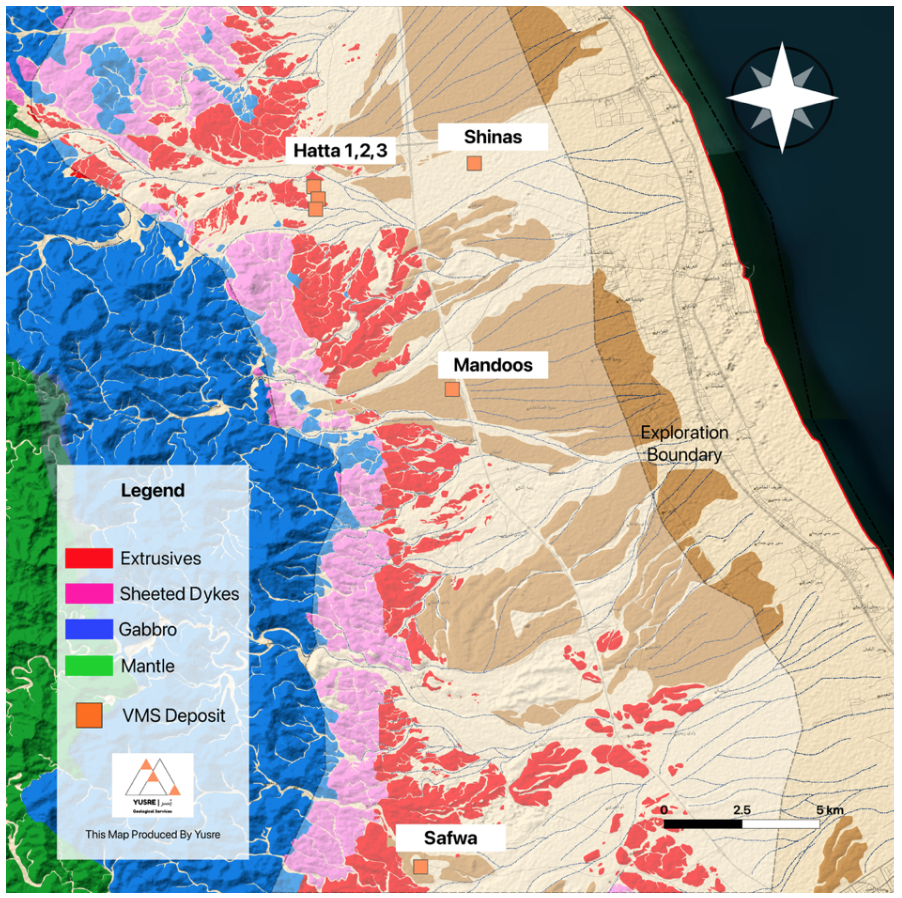
Hydrothermal alteration mapping is one of the most effective exploration tools in Oman’s VMS systems. Chlorite-rich zones typically indicate proximity to feeder systems and stockwork mineralization, while silicic and sericitic alteration halos may outline the broader hydrothermal footprint. Identifying vertical and lateral alteration zoning helps vector exploration toward higher-grade copper–gold zones.
Geochemical surveys play a central role in early-stage exploration. Soil, rock chip, and stream sediment sampling are used to detect anomalies in copper, gold, zinc, and pathfinder elements such as arsenic and cobalt. Elevated copper and gold values, particularly when spatially associated with chloritic alteration and structural corridors, provide strong targeting indicators. In addition, systematic sampling of gossans—oxidized surface expressions of sulphide bodies—has historically led to several discoveries.
Geophysical methods are widely applied to detect concealed sulphide bodies. Airborne and ground-based electromagnetic (EM) surveys are particularly effective, as massive sulphide lenses are electrically conductive. Induced polarization (IP) surveys help identify disseminated sulphides within stockwork zones. Magnetic surveys assist in mapping volcanic stratigraphy and structural features, while gravity surveys may highlight dense massive sulphide accumulations.
Advanced exploration programs integrate multiple datasets within a GIS framework to generate priority targets. Once targets are defined, diamond drilling is undertaken to confirm sulphide thickness, grade distribution, and depth continuity. Core logging emphasizes alteration intensity, sulphide texture, and structural orientation, which are essential for resource modeling and understanding ore controls.
Modern exploration in Oman also revisits historically mined districts using updated geological models and improved subsurface imaging techniques. Many known deposits remain open at depth, and deeper feeder systems beneath previously mined massive sulphide lenses represent significant exploration potential.
Yanqul Deposits
The Yanqul region in north-western Oman is part of a larger copper–gold mineralized belt hosted within the volcanic and volcaniclastic succession of the Oman Ophiolite. This belt is broadly identified along structural corridors where submarine hydrothermal systems were active during oceanic crust formation in a supra-subduction zone environment. The volcanic package in this area includes basaltic and andesitic flows, breccias, and associated volcaniclastic rocks, underlain and overlain locally by sheeted dykes and minor intrusive units. These stratigraphic and structural assemblages provide the primary framework for copper–gold mineralization.
Copper/gold mineralization in the Yanqul area is interpreted within the Volcanogenic Massive Sulphide (VMS) model, where metal-rich hydrothermal fluids were driven by magmatic heat through permeable volcanic sequences. These fluids precipitated copper and iron sulphides at or below the paleo-seafloor, forming stratiform to lensoid sulphide bodies with associated gold enrichments. Subsequent tectonic uplift, obduction of the ophiolite, and late-stage deformation have exposed the mineralization at surface, with secondary enrichment and weathering locally modifying sulphide zones.
Major Deposits
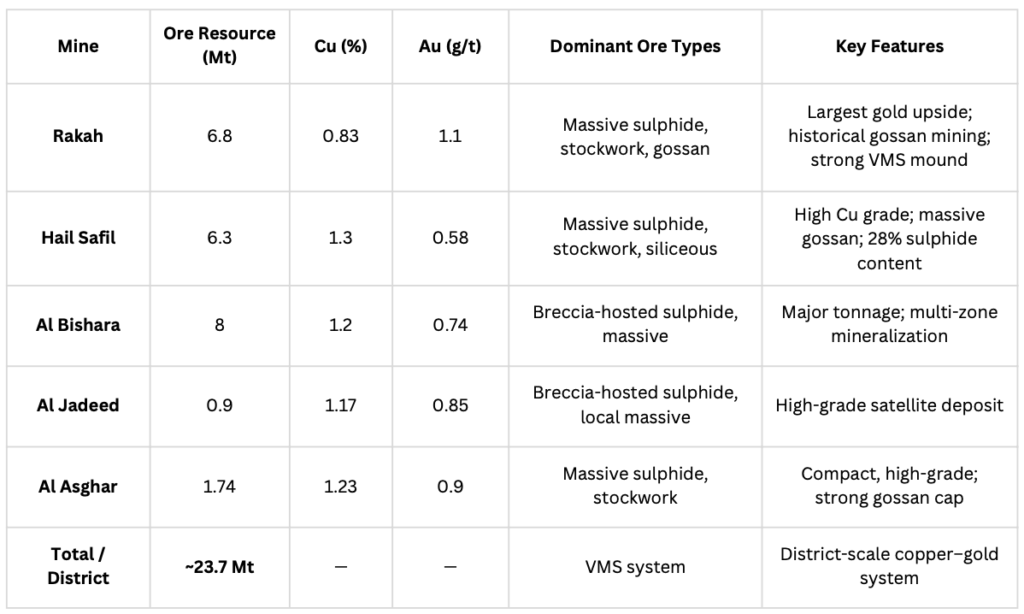
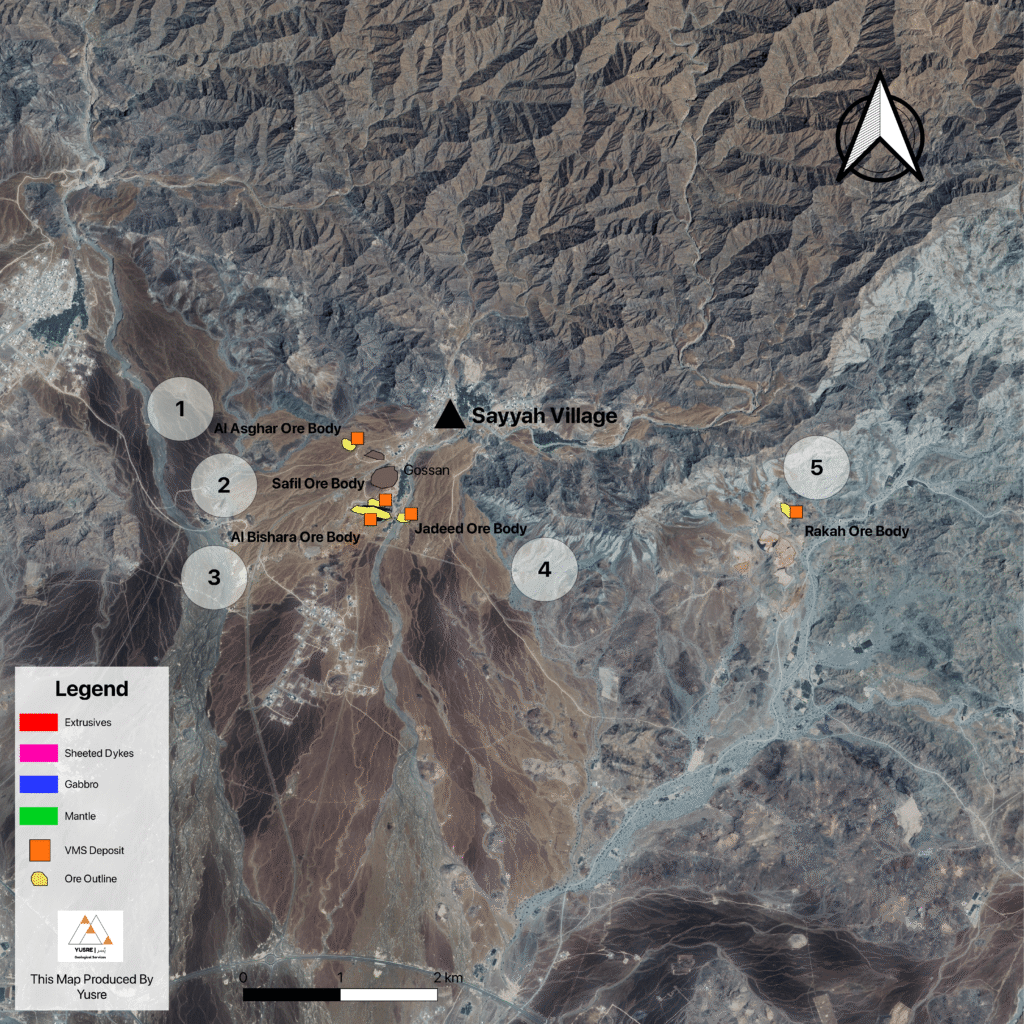
Within the Yanqul district, five principal copper–gold occurrences have been delineated through systematic geological investigation, surface mapping, geochemistry, trenching, and drilling. These occurrences form discrete mineralized zones within the volcanic stratigraphy and collectively comprise a significant base metal resource.
- Al Asghar Deposit
Al Asghar Mine is one of the five recognized deposits within the Yanqul region and represents a compact but high-grade VMS system. Although smaller in tonnage compared to Al Bishara and Rakah, Al Asghar is distinguished by elevated copper and gold grades, a well-developed gossan cap, and a dominance of massive sulphide mineralization, making it an important contributor to the overall economic and geological framework of the Yanqul district. - Hayal As Safil Deposit
Hail Safil Mine is one of the five key deposits within the Yanqul region, forming part of the district-scale VMS mineral system. It hosts approximately 6.3 million tonnes of ore with relatively high copper grades (1.3% Cu) and moderate gold (0.58g/t Au). The presence of a massive gossan cap, multiple ore types, and well-defined structural and stratigraphic controls underscores its economic significance and exploration potential. The ore body at Hail Safil is well-defined and structurally controlled, with a west-to- east dip and massive sulphide lenses forming mound-like structures above stockwork zones. Sulphide minerals make up approximately 28% of the ore by weight, with chalcopyrite as the dominant copper mineral. Secondary minerals such as covellite and chalcocite occur in minor amounts. Fine-grained copper grains are frequently encapsulated within pyrite, which has direct implications for processing and recovery methods. - Al Bishara & Al Jadeed Deposit
Al Bishara and Al Jadeed are genetically related VMS deposits within the Yanqul region and represent a continuous mineralized corridor controlled by regional NW–SE structures. Together, they contribute significantly to the overall copper/gold endowment of the district, with Al Bishara forming a medium-scale, high-quality resource, while Al Jadeed represents a high-grade satellite deposit with strong upside potential. Al Bishara hosts approximately 8 million tonnes of ore, characterized by strong copper grades (1.2 % Cu) and meaningful gold enrichment (0.74 g/t Au), placing it among the higher-quality VMS deposits in the Yanqul district. Al Jadeed, although smaller in tonnage (~0.9 Mt), exhibits comparable copper grades and slightly higher gold content, making it an attractive high-grade satellite deposit. The combined resource strengthens the economic resilience of the Yanqul Project by balancing tonnage and grade across multiple deposits. - Rakah Deposit
Rakah Mine is one of the five key deposits within the Yanqul region, representing a cornerstone of the district-scale VMS mineral system. It hosts approximately 6.8 million tonnes of ore with moderate copper grades (0.83%) and notable gold content (1.1g/t), including localized zones of exceptionally high gold up to 9.1g/t. The deposit’s robust resource base, multiple ore types, and well-defined structural and stratigraphic controls make it a model deposit for understanding and exploring other mines within the Yanqul district. Rakah’s combination of copper and gold mineralization, together with its shallow, accessible gossan cap, highlights its economic significance and exploration potential within the emerging Omani copper/gold belt.
Resource and Reserve Overview
Detailed subsurface investigations and resource studies have defined approximately 22.9 million tonnes of copper-bearing ore within the Yanqul mineralized corridor. These reserves are distributed across the five main deposits, with individual mineralized bodies intersecting sulphide thicknesses from a few meters to tens of meters, depending on structural focus and hydrothermal intensity. Copper grades within these deposits generally range from 0.7% to 1.8% Cu, with higher values locally associated with semi-massive and massive sulphide lenses. Gold grades typically range from 0.3 to 1.5 g/t Au, with highest values occurring where chalcopyrite is most abundant and alteration intensity is elevated. Silver, while present, is generally a minor by-product relative to copper and gold.
Geological Interpretation
The Yanqul copper/gold mineralization can be interpreted within the broader ophiolite framework, where hydrothermal fluid flow was focused along permeable volcanic horizons and structural conduits. The stratigraphy at Yanqul exhibits repeated sequences of pillowed basalt, volcaniclastic breccias, and sheeted dyke zones, facies that are highly conducive to hydrothermal convection. Hydrothermal alteration halos are well developed around sulphide bodies and include chloritic cores, silicic halos, and, in some cases, sericitic overprints — classic signatures of VMS systems. Structural fabrics — particular