
Deposit Profile
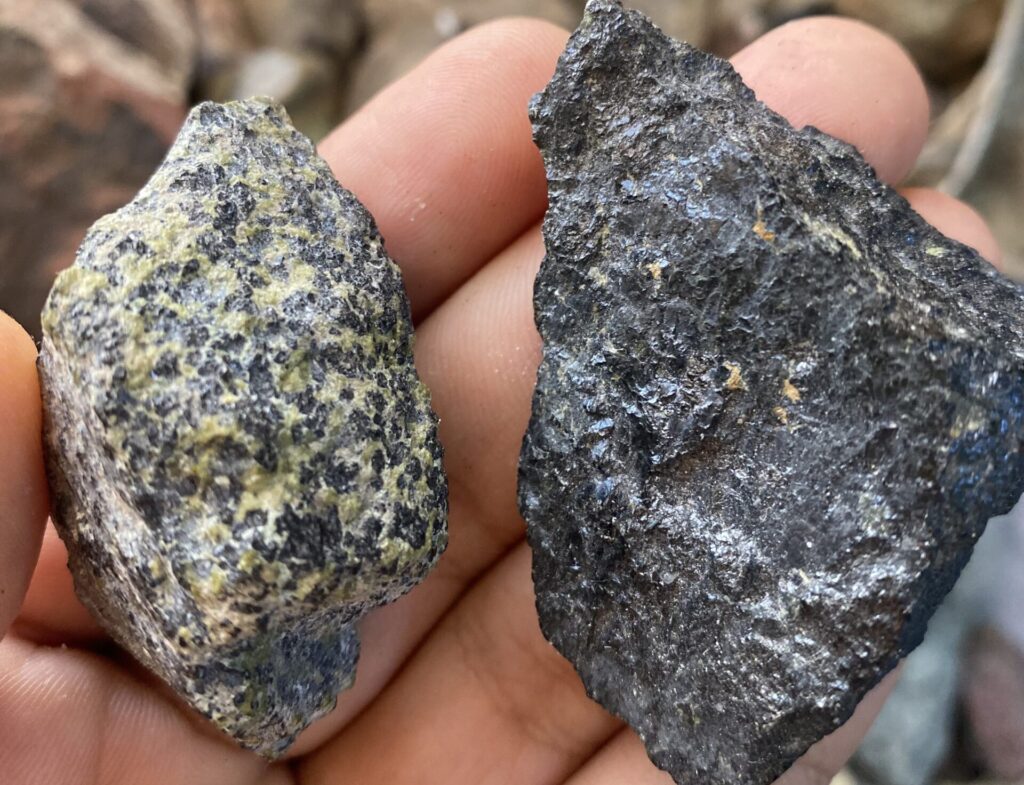
Primary Commodity:
Chromium (Cr₂O₃) derived from Chromite
Associated Commodities:
Locally Nickel (Ni), Cobalt (Co), and Platinum Group Elements (PGE) in minor concentrations
Deposit Type:
Podiform Chromite
Mantle-hosted ophiolitic chromite bodies
Host Rocks:
Dunite, harzburgite, and serpentinized peridotite within the mantle sequence of the Oman Ophiolite
Tectonic Setting:
Supra-subduction zone (SSZ) oceanic lithosphere; upper mantle section of obducted ophiolite complex
Ore Minerals:
Chromite (FeCr₂O₄) — dominant ore mineral
Accessory / Minor Minerals:
Magnetite, olivine, serpentine, minor sulfides (locally pentlandite or millerite in trace amounts)
Gangue Minerals:
Olivine, serpentine, pyroxene, magnetite
Alteration Style:
Serpentinization of ultramafic host rocks; localized talc-carbonate alteration along shear zones
Structural Controls:
Mantle shear zones, dunite channels, melt-flow conduits, and tectonic contacts between harzburgite and dunite; podiform bodies aligned along structural trends
Mineralization Style:
Podiform lenses, irregular tabular bodies, disseminated chromite bands, and massive chromitite pods within dunite envelopes
Typical Grades:
Cr₂O₃: ~30–48% (locally >50%)
Cr/Fe ratio: ~2.5–3.5 (metallurgical grade)
Deposit Scale:
Small to medium-sized pods (thousands to several hundred thousand tonnes per body); collectively significant at district scale across northern Oman
Exploration Status:
Historical and ongoing mining; continued exploration targeting deeper concealed pods and structurally controlled dunite channels within ultramafic belts
Geological Setting
Chromite mineralization in Oman is genetically associated with the mantle section of the Oman Ophiolite, one of the largest and best-preserved ophiolite complexes in the world. The ophiolite represents a complete section of oceanic lithosphere, comprising deep mantle peridotites, layered and isotropic gabbros, sheeted dyke complexes, and volcanic sequences. It was emplaced (obducted) onto the Arabian continental margin during the Late Cretaceous, preserving the internal architecture of oceanic crust and upper mantle formed in a supra-subduction zone (SSZ) environment.
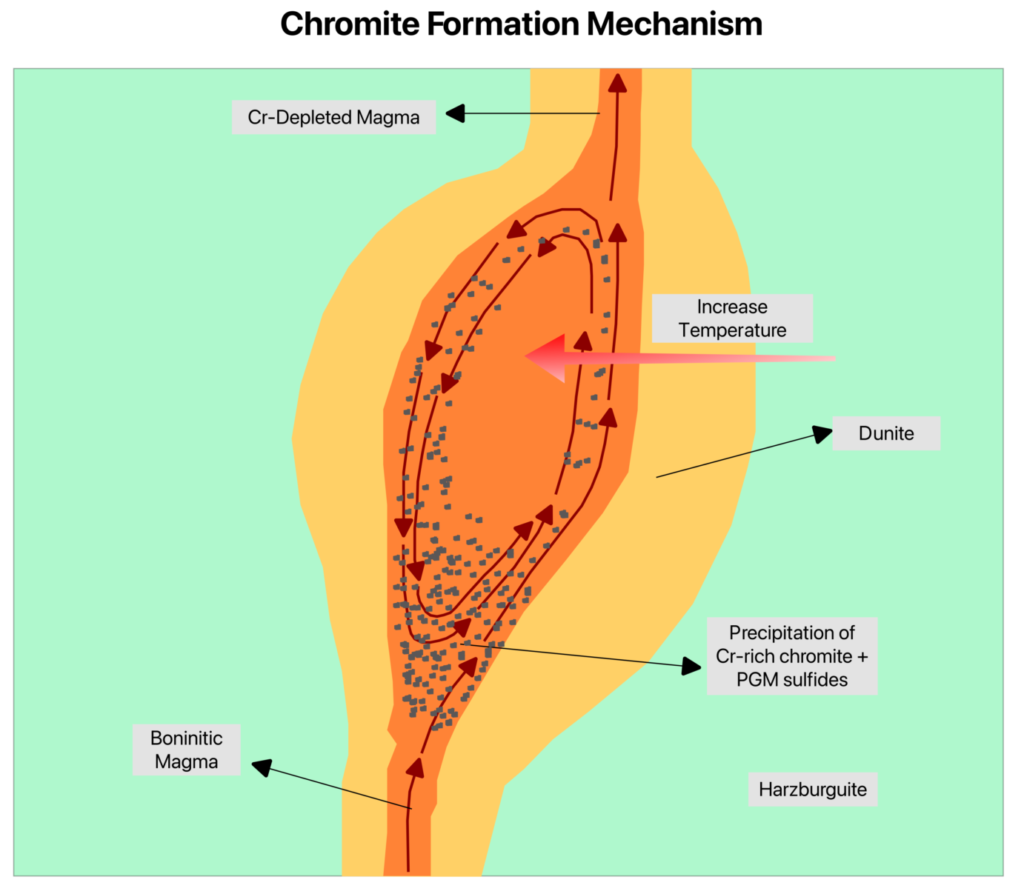
Chromite deposits are primarily hosted within the mantle sequence, particularly in harzburgite and dunite. These ultramafic rocks represent residues of partial melting of the upper mantle. Chromite formation is closely linked to high-degree partial melting and melt–rock interaction processes in a supra-subduction zone setting, where boninitic and basaltic melts percolated through depleted mantle peridotites. As these melts migrated through the mantle wedge, they reacted with harzburgite, forming dunite channels and concentrating chromium in localized zones.
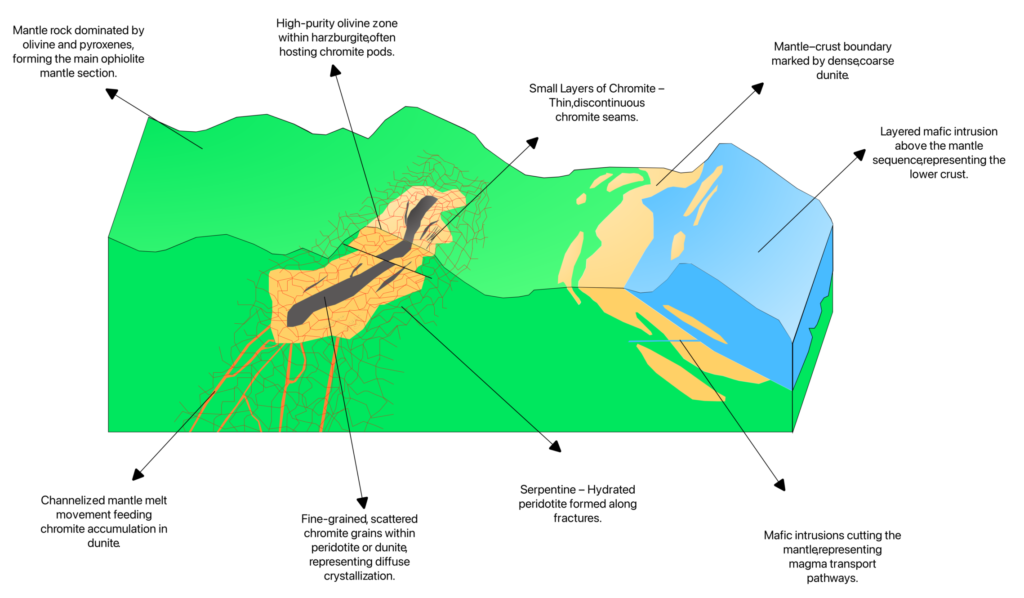
The dominant deposit type is podiform chromite, characterized by irregular, lens-shaped to tabular bodies enclosed within dunite envelopes. These pods commonly occur along mantle shear zones, melt conduits, and structural boundaries between harzburgite and dunite. Their geometry is typically discontinuous and structurally controlled, reflecting deformation during mantle flow and later tectonic emplacement. Chromite bodies often align along linear trends corresponding to paleo-melt pathways and tectonic fabrics developed during oceanic spreading and subduction-related magmatism.
The formation process involves the crystallization of chromite from high-temperature, chromium-rich melts under conditions of reduced pressure and high oxygen fugacity typical of supra-subduction environments. Rapid changes in melt composition during interaction with mantle peridotite lead to chromite saturation and precipitation. Subsequent deformation, mantle flow, and obduction further modified the shape and distribution of chromite pods.
Following emplacement onto the Arabian margin, regional tectonic uplift and weathering exposed the ultramafic sequences, making chromite bodies accessible for exploration and mining. Serpentinization of peridotite is widespread, but primary chromite mineralization remains largely preserved due to its chemical stability.
Overall, chromite in Oman reflects mantle-derived magmatic processes in a supra-subduction zone setting, structurally focused within dunite channels of the ophiolitic mantle sequence. The preserved tectono-magmatic architecture of the Oman Ophiolite provides a globally significant natural laboratory for understanding podiform chromite genesis and mantle metallogeny.
Hydrothermal Alteration
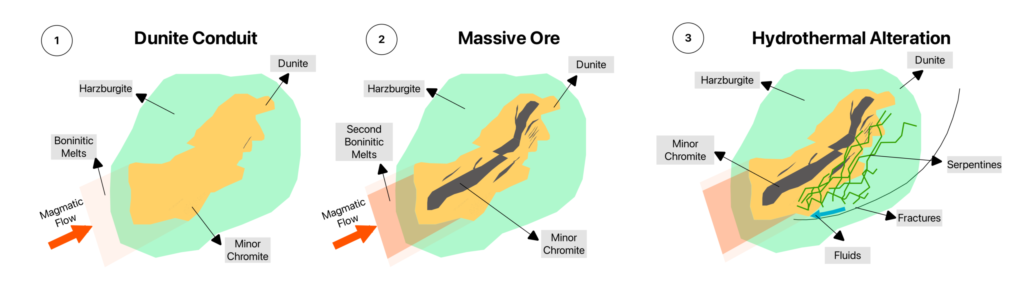
Chromite deposits in the Oman Ophiolite are primarily magmatic in origin, but hydrothermal processes have locally modified the host ultramafic rocks and ore zones. Hydrothermal alteration is typically associated with fluid circulation along shear zones, dunite channels, and structural contacts between harzburgite and dunite, where fractures and permeability allowed interaction with chromium- and silica-bearing fluids.
The most common alteration observed is serpentinization, where primary olivine and pyroxene in the ultramafic host rocks are replaced by serpentine minerals. This process occurs at relatively low temperatures and involves the addition of water, often accompanied by minor formation of magnetite. Serpentinization does not significantly degrade the chromite ore but can influence the physical properties of the host rock, affecting mining and processing.
Talc-carbonate alteration is occasionally observed, particularly along fault zones or where ultramafic rocks interacted with CO₂-rich fluids. This type of alteration produces talc and magnesite or calcite, which may form along chromite pod margins or in fracture zones. Talc-carbonate alteration can locally decrease ore density and hardness but does not typically reduce chromium grade.
Minor hydrothermal sulfide mineralization can occur in structurally controlled zones, introducing trace amounts of nickel, cobalt, or platinum-group elements. These zones are often associated with the margins of chromite pods where fluid-rock interaction was most intense.
Hydrothermal alteration in Oman’s chromite deposits is therefore secondary and localized, primarily affecting the host ultramafic rocks and marginal zones of chromite pods rather than the main chromite body itself. Understanding the nature and extent of hydrothermal alteration is important for mine planning, processing efficiency, and resource evaluation, as it can influence rock competency, drill core interpretation, and beneficiation strategies.
Wadi Farfar – Hilti
Geological and Stratigraphic Setting
The Hilti–Farfar chromite deposits are located within the deeper mantle section of the northern Oman ophiolite. These deposits represent a structurally and petrologically complex chromitite system developed within the mantle transition zone (MTZ). On map section, the chromitite bodies occur approximately 9–10 km below the Moho, although variations in Moho dip locally produce a shallower apparent depth relative to other chromite districts. Chromitite pods are hosted by mantle harzburgite and dunite and are closely associated with networks of dunite channels as well as mafic and ultramafic dykes. The chromitite bodies typically display sharp contacts with surrounding MTZ dunites, which themselves enclose relic lenses of mantle harzburgite. This lithological architecture reflects focused melt transport and localized melt–rock interaction within the mantle section, emphasizing the importance of melt channelization during chromite formation.
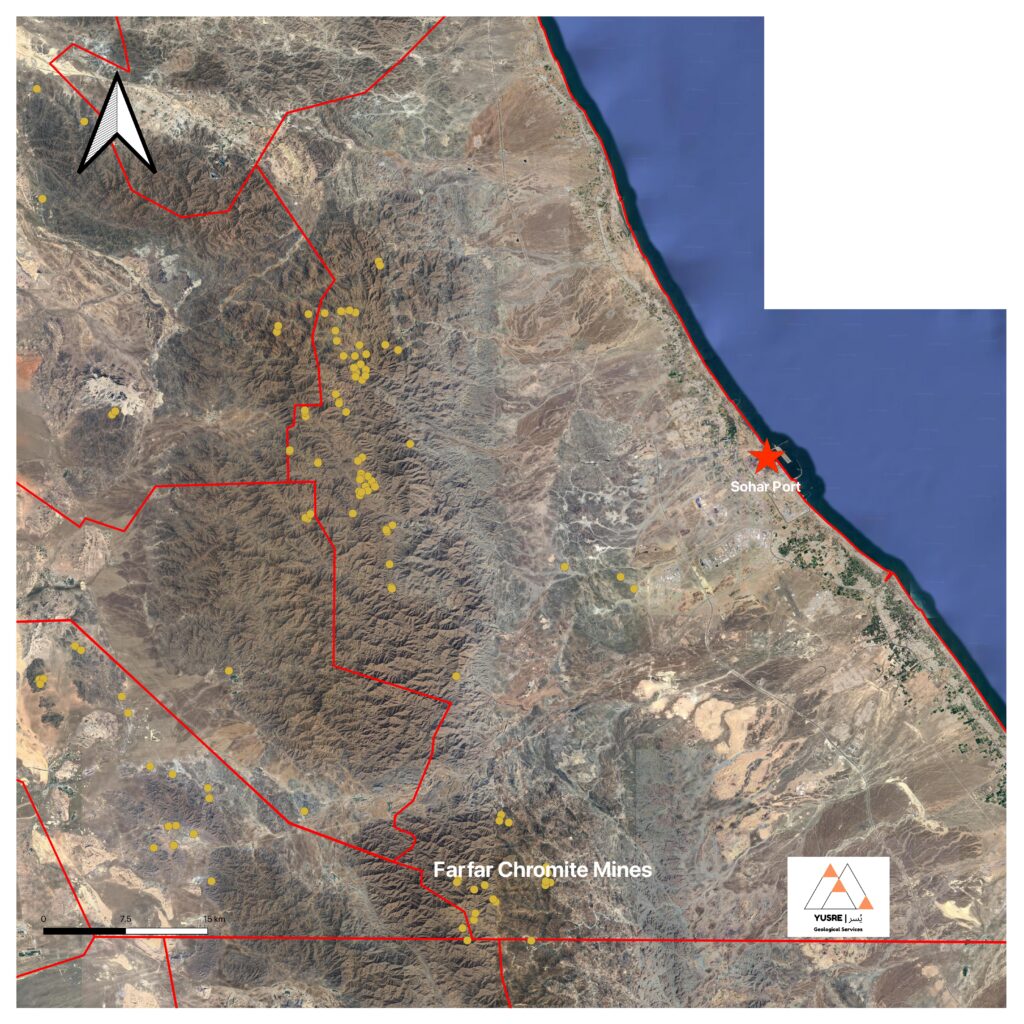
Deposit Morphology and Dimensions
Chromite mineralization in the Hilti–Farfar district occurs in multiple geometries, including irregular bodies, pencil-shaped forms, layered horizons, and tabular lenses. Individual chromitite bodies commonly range from approximately 0.2 to 3 m in thickness, with lateral extensions between 3 and 210 m. Two principal chromitite body types are recognized in the Wadi Hilti area:
- Concordant chromitite pods aligned with the foliation of mantle dunite and harzburgite, reaching lengths of up to approximately 10 m.
- Later, narrow chromitite dykes (around 50 cm wide) that are discordant to the surrounding mantle fabric.
Chromitite margins may be irregular or diffuse, with interleaving of chromitite and dunite over distances of up to approximately 1 m. These features reflect syn-magmatic deformation and incomplete mineral segregation during chromite accumulation.
Grain Size and Textural Characteristics
Chromite grain size within the Hilti–Farfar chromitites ranges from approximately 0.1 to 3 mm. Modal chromian spinel contents are generally less than 74%, and olivine is relatively well preserved compared to chromitites from other districts. The chromitites of Wadi Farfar are particularly notable for their high abundance of mineral inclusions. Amphibole inclusions are especially common. Disseminated, nodular, and anti-nodular chromitites consistently contain more inclusions than associated massive chromitites. This textural variability indicates prolonged melt–rock interaction and locally elevated volatile activity during chromite crystallization.
Mineral Chemistry and Melt–Rock Interaction
Olivine associated with chromitite bodies typically exhibits forsterite contents of approximately Fo90–91, comparable to or slightly lower than adjacent harzburgite and concordant dunite. Spinel chemistry shows strong spatial variability, particularly within discordant dunite networks. The Cr-number (Cr#) of chromian spinel is strongly dependent on dunite thickness, with higher Cr# values occurring in thicker dunite bodies and lower values in thinner ones.
Harzburgite adjacent to dunite channels displays clear evidence of chemical modification by infiltrating melts, particularly in spinel composition. Chromian spinel within dunite exhibits pronounced grain-to-grain chemical heterogeneity, even at thin-section scale, indicating rapid crystallization from chemically evolving melts. Slightly elevated TiO₂ contents in spinel from discordant dunite relative to harzburgite further reflect subtle variations in melt composition and crystallization conditions.
Wadi Rajmi – Sohar
Structural and Geological Setting
The Wadi Rajmi chromite deposits are situated in the northern sector of the Oman ophiolite and are structurally controlled by a dominant system of NW–SE trending shear zones. These shear zones represent major mantle-scale deformation corridors that played a critical role in melt focusing, magma transport, and chromite localization. Chromite mineralization is spatially aligned with these shear zones, demonstrating a strong genetic relationship between deformation, melt migration, and ore formation. Mafic dykes are abundant throughout the Wadi Rajmi area and consistently display NW–SE orientations parallel to the main shear fabric. Their mafic composition indicates repeated injection of mantle-derived melts during progressive tectono-magmatic evolution. These dykes acted as feeders and transient melt conduits, promoting localized thermal anomalies and enhanced melt–rock interaction.
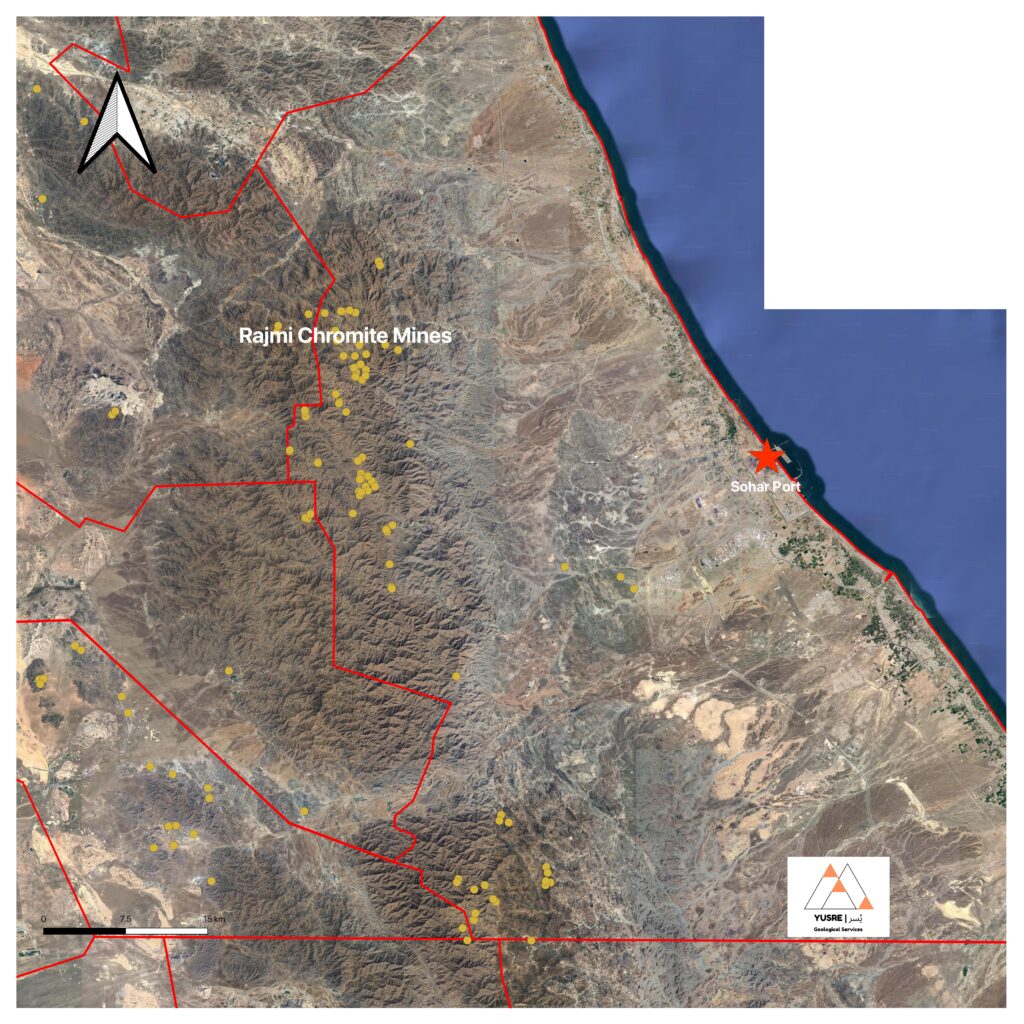
Stratigraphic Position and Depth Distribution
Chromite deposits at Wadi Rajmi are developed predominantly above the Moho, within a vertical range of approximately 0 to 6.5 km. Most economic mineralization occurs near the Moho transition zone, highlighting the importance of this boundary as a site of melt focusing and chromite saturation. The relatively shallow stratigraphic position of many deposits suggests efficient melt extraction and accumulation at the crust–mantle interface, a characteristic feature of podiform chromite systems in ophiolitic environments.
Deposit Geometry and Dimensions
Chromite bodies at Wadi Rajmi exhibit diverse morphologies, including tabular, lens-shaped, podiform, and irregular forms. Individual deposits typically range from 0.5 to 3 m in thickness, with lateral extensions between 12 and 300 m. This variability reflects differences in melt flux, deformation intensity, and structural control during chromite precipitation and accumulation. The predominance of tabular and lensoid geometries indicates syn-tectonic emplacement, where chromite accumulated within shear-related dilation zones and transient melt pooling along structural discontinuities.
Reserves and Grade Characteristics
Estimated chromite reserves in the Wadi Rajmi district range from approximately 500 tonnes to 600,000 tonnes per deposit. The Mahara 1 deposit represents the largest known accumulation in the district, with estimated reserves of approximately 600,000 tonnes. Chromite grades are consistently high, ranging between 41% and 50% Cr₂O₃. These grade levels confirm the economic significance of the district and its suitability for selective underground or small-scale open-pit extraction.
Haylayn Massif
Regional Geological Setting
The Haylayn Massif represents one of the most complete, laterally continuous, and structurally informative exposures of upper mantle within the Oman ophiolite, preserving an exceptional natural cross-section through oceanic lithosphere that formed at a spreading center and was subsequently emplaced onto the Arabian continental margin during the Late Cretaceous obduction event. Unlike many ophiolitic fragments that are tectonically dismembered or incomplete, the Haylayn Massif retains a coherent mantle section in which primary magmatic features, melt pathways, and deformation structures are preserved together, allowing direct interpretation of mantle processes in both spatial and temporal context. This massif is therefore not simply a remnant of oceanic mantle, but a dynamically evolved system that records successive stages of lithospheric development, from initial melt generation and extraction to later deformation and structural reorganization.
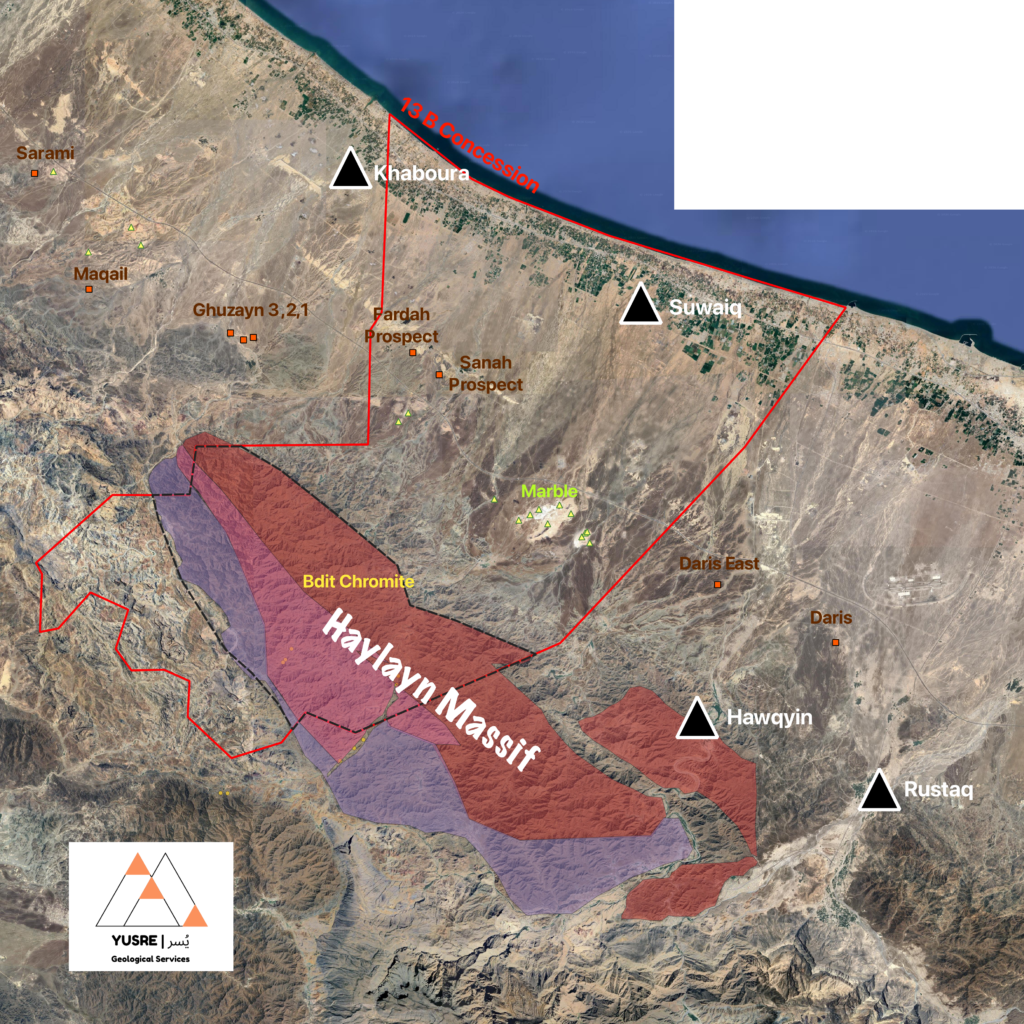
Figure, Satallite image of Haylayn Massif and 13B Concession.
The geological significance of the massif lies in its ability to preserve the interplay between thermal structure, melt production, and tectonic deformation within a spreading environment that was not uniform, but rather segmented and evolving. Variations observed across the massif reflect changes in melt supply, degree of partial melting, and efficiency of melt extraction, all of which are controlled by the geodynamic setting of ridge propagation and lithospheric accretion. In such a system, melt is not generated or transported uniformly; instead, it becomes focused into discrete pathways that evolve over time, resulting in a heterogeneous mantle architecture. The Haylayn Massif captures this complexity through the coexistence of relatively fertile mantle domains and highly depleted regions, indicating that different parts of the massif experienced different conditions of melting and melt interaction.
Furthermore, the massif provides clear evidence that mantle processes are closely linked to deformation under high-temperature conditions. The preservation of ductile fabrics, folding, and structural transposition within the mantle sequence demonstrates that deformation occurred contemporaneously with or shortly after melt extraction, leading to reorganization of primary lithological relationships. This coupling between deformation and melt migration is essential for understanding how melt pathways are initiated, maintained, and modified within the mantle. Rather than being static features, these pathways evolve in response to both thermal gradients and stress fields, resulting in a complex network of melt conduits that reflect the dynamic nature of the spreading system.
Overall, the Haylayn Massif represents a highly heterogeneous but internally consistent geological system, in which variations in lithology, structure, and geochemistry can be directly linked to changes in mantle processes through time. Its exceptional preservation allows for a detailed reconstruction of oceanic lithosphere formation, making it a critical reference for understanding how melt is generated, transported, and focused within the upper mantle, and how these processes are modified by tectonic deformation during and after lithospheric accretion.
Structural Domains of the Massif
The Haylayn Massif is characterized by a clear internal subdivision into two principal structural domains, each reflecting distinct stages of mantle evolution and melt dynamics: the eastern Beni Gafir domain and the western Main Mantle Sequence. This division is not merely geographic, but fundamentally geological, capturing the transition from a marginal, weakly developed spreading environment to a more mature and dynamically evolved mantle system. The contrast between these domains is expressed in their structural architecture, lithological distribution, and geochemical signatures, all of which provide critical insights into the spatial variability of melt generation and transport within the mantle.
The Beni Gafir domain represents a relatively small and shallow mantle exposure, interpreted as the tip of a propagating ridge system where spreading processes were incomplete and melt extraction was inefficient. In this setting, the mantle retains a relatively fertile character, and melt pathways are poorly organized and spatially dispersed. Structurally, this domain lacks the intense deformation and transposition observed in deeper parts of the massif, suggesting that it was not subjected to the same degrees of high-temperature tectonic reworking. The limited thickness of the exposed mantle and the absence of large-scale melt conduits indicate that melt flux was low and that melt migration occurred through small, discontinuous pathways rather than through well-developed channel systems. This results in a relatively simple structural framework, where primary mantle features are preserved with minimal overprinting.
In contrast, the Main Mantle Sequence forms the dominant structural and geological component of the massif, extending to an estimated thickness of approximately 5 km and preserving a much more complex history of deformation and melt interaction. This domain is interpreted to represent older lithospheric mantle that may have formed prior to the ridge propagation event, and its internal structure reflects significant tectonic reorganization under high-temperature conditions. The sequence is subdivided into a lower structurally transposed unit and an upper unit intruded by magmatic dykes, indicating multiple phases of deformation and melt activity. The lower unit is characterized by intense ductile deformation, including folding and shearing, which has reoriented primary mantle fabrics and produced a transposed structural configuration. This deformation is closely linked to melt migration processes, suggesting that stress fields played a key role in focusing melt into specific pathways.
The upper part of the Main Mantle Sequence records a different structural regime, where deformation is less intense and is overprinted by intrusive activity in the form of pyroxenite and gabbro dykes. These intrusions indicate continued magmatic activity after the main phase of mantle deformation, reflecting a stage in which melt was injected into an already established mantle framework. The presence of these dykes demonstrates that the massif did not evolve in a single event, but rather through a sequence of interconnected processes involving melt generation, migration, deformation, and intrusion.
Structural Control and Mantle Architecture
The Haylayn Massif displays a highly organized structural framework that reflects extensive deformation under high-temperature conditions, providing key insight into the interplay between tectonics and melt migration within the upper mantle. This mantle sequence is not a static or purely magmatic system; rather, it has undergone significant ductile deformation, including pervasive folding, shearing, and the development of strong fabric alignment. These processes occurred while the mantle remained at elevated temperatures, allowing minerals to deform plastically and resulting in the reorganization and stretching of primary lithological layers.
A critical aspect of the massif is the presence of structurally transposed domains, particularly within the lower Main Mantle Sequence. In these regions, the original layering and compositional variations have been rotated, stretched, and reoriented by sustained deformation, producing fabrics that directly reflect mantle flow and regional stress orientations. This indicates that deformation was closely coupled with melt migration: the stress fields did not simply overprint pre-existing structures but actively guided the localization and direction of melt pathways. Melt transport was therefore not random but focused along zones of enhanced permeability created by deformation.
Dunite bodies within the massif provide clear evidence of this structural control. These bodies are aligned along discrete structural trends rather than being randomly distributed. They occupy zones of increased permeability within the mantle, where repeated melt flow and reactive melt–rock interaction transformed the host harzburgite into olivine-rich channels. The orientation of these dunite bodies demonstrates that deformation played a central role in focusing melt into stable conduits, influencing both their size and distribution.
Furthermore, the orientation of mantle fabrics is coherent with overlying crustal structures, such as the alignment of sheeted dyke complexes. This suggests that mantle deformation and magmatic processes were not independent but part of a continuous lithospheric system, where the geometry of melt transport pathways was directly linked to the regional tectonic regime and the direction of lithospheric extension. The coupling of tectonics and magmatism allowed for the development of highly efficient melt channels in the lower sequence, while the upper sequence exhibits smaller, structurally controlled dunite bodies reflecting localized melt intrusion.
Melt–Rock Interaction and Mantle Evolution
The Haylayn Massif provides a remarkable record of the complex interactions between ascending melts and the surrounding mantle peridotites, which are essential for understanding the formation and evolution of dunite bodies. Melt–rock interaction in this system is dominated by reactive melt flow, a process in which migrating melts dissolve pyroxene minerals from harzburgite while leaving olivine largely unaffected. This selective dissolution results in olivine-enriched channels, producing the thick, continuous dunite bodies observed in the lower Main Mantle Sequence. The degree of reaction and the resulting dunite thickness are directly proportional to the intensity and duration of melt flow, meaning that large dunite bodies correspond to regions of sustained high melt flux, whereas smaller, discontinuous dunites form where melt transport was more limited.
This process also provides a link between melt composition, mantle depletion, and lithology. In the lower Main Mantle Sequence, dunites display extreme depletion in light rare earth elements (LREEs) and high forsterite content in olivine, indicating formation from highly depleted melts. These features reflect a system in which melt extraction was highly efficient, leaving a refractory, olivine-dominated residue. By contrast, dunites in the upper sequence show intermediate depletion and slightly lower forsterite contents, consistent with formation under lower melt flux and potentially mixed melt sources. The progressive variation in chemical signatures across the massif captures a continuum from fertile mantle, through highly depleted lower-sequence dunites, to late-stage, structurally controlled intrusions.
The structural setting of the massif plays a fundamental role in controlling melt–rock interaction. High-temperature deformation, including folding, ductile shearing, and transposition of fabrics, creates zones of enhanced permeability that focus and stabilize melt pathways. These zones act as conduits where reactive flow is concentrated, promoting the growth of large dunite bodies and the formation of aligned channel systems. Without this structural guidance, melt would have migrated more diffusely, resulting in thin, isolated dunites rather than the thick, continuous bodies observed. Thus, deformation and melt transport are tightly coupled processes, with structural features both directing melt ascent and recording the dynamics of mantle flow.
Overall, the Haylayn Massif demonstrates that dunite formation is not a passive magmatic process but a dynamic record of mantle evolution, reflecting the interaction between melt composition, melt flux, and tectonic deformation. The massif preserves a full spectrum of melt–rock interaction, from localized small-scale channels in marginal domains to extensive, highly reactive conduits in the lower Main Mantle Sequence. This provides an unparalleled window into the mechanisms of melt generation, transport, and lithospheric modification in a spreading center environment.