Deposit Profile
Primary Commodity:
Nickel (Ni)
Associated Commodities:
Cobalt (Co), Iron (Fe)
Deposit Type:
Nickel laterite (supergene weathering deposit)
Host Rocks:
Serpentinized ultramafic rocks (harzburgite and dunite) of the Semail Ophiolite
Locally layered gabbro
Tectonic Setting:
Formed after obduction of the Semail Ophiolite onto the Arabian Plate during the Late Cretaceous
Developed under tropical to subtropical weathering condition
Ore Minerals:
Nickel-bearing serpentine (nepouite)
Goethite (Ni-bearing)
Willemseite
Minor garnierite-type minerals
Gangue Minerals:
Serpentine
Talc
Chlorite
Kaolinite
Iron oxides
Alteration Style:
Intense chemical weathering (lateritization)
Leaching of magnesium and silica
Residual enrichment of iron, nickel, and cobal
Structural / Geomorphological Controls:
Developed on exposed ultramafic rocks
Best preserved on stable plateaus and gentle slopes
Thickness affected by erosion and drainage
Mineralization Style:
Vertical weathering profile
Nickel concentrated in saprolite and oxide zones
Lens-shaped laterite caps
Typical Grades:
Nickel: ~0.3–0.8% Ni
Cobalt: ~0.02–0.08% Co
Deposit Scale:
Small to medium-sized deposits
Thickness commonly 5–20 m
Lateral extent tens to hundreds of meters
Exploration Status:
Mapped and sampled in several areas (Ibra, East Ibra, Al-Russayl, Tiwi)
Some areas require further drilling and evaluation
Geological Setting
Laterite deposits in the Oman Mountains are genetically linked to the emplacement and subsequent exposure of the Semail Ophiolite, a vast section of oceanic lithosphere that was obducted onto the northeastern margin of the Arabian Plate during the Late Cretaceous (Campanian–Maastrichtian). This tectonic event uplifted and exposed large expanses of mantle-derived ultramafic rocks, particularly harzburgite and dunite, together with layered gabbros and mafic intrusions, to subaerial conditions. The exposure of these magnesium-rich and silica-poor lithologies created the essential geological precondition for laterite formation. Unlike continental cratonic laterites that develop over granitic or sedimentary protoliths, Omani laterites are distinctly ophiolite-hosted and therefore inherit the unique geochemical signature of ultramafic rocks, including elevated background nickel and chromium contents.
Following obduction, the ophiolite surface experienced a prolonged period of tectonic stability and tropical to subtropical climatic conditions, which promoted deep and sustained chemical weathering. Under warm temperatures and high rainfall, meteoric waters percolated through fractures and permeable serpentinized zones, initiating intense hydrolysis and oxidation reactions. Mobile elements such as magnesium and silica were progressively leached from the profile, while relatively immobile elements—particularly iron, aluminum, nickel, and cobalt—became residually enriched. This process of lateritization resulted in the gradual transformation of fresh ultramafic bedrock into a vertically zoned weathering profile characterized by strong geochemical gradients and mineralogical alteration.
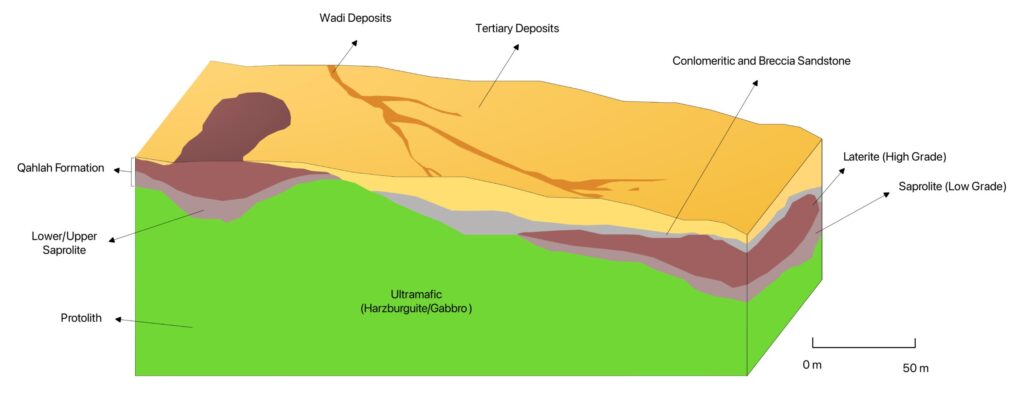
Stratigraphically, laterite development in Oman is closely associated with the Qahlah Formation, which unconformably overlies the Semail Ophiolite. The Qahlah Formation consists mainly of polymict conglomerates, sandstones, and ferruginous materials derived from the erosion of weathered ophiolitic rocks. The presence of ferricrete horizons and iron-rich detritus within this formation provides evidence for widespread lateritic weathering during or slightly before its deposition. This indicates that laterite formation was broadly contemporaneous with early post-obduction sedimentation, representing a period of surface stability and intense chemical alteration prior to burial by younger Maastrichtian–Paleogene carbonate sequences.
The laterite profiles themselves typically display a well-developed vertical zonation reflecting progressive alteration and element redistribution. At depth, fresh or weakly weathered ultramafic bedrock preserves primary mineral assemblages such as olivine and pyroxene, though these are often serpentinized. Above this lies the saprolite zone, where primary rock textures may still be recognizable but primary silicate minerals are largely replaced by secondary hydrous silicates, including nickel-bearing serpentine and talc-group minerals. This zone commonly hosts the highest nickel concentrations in silicate-type laterites. Overlying the saprolite is an oxide-rich laterite (limonite) zone dominated by iron oxyhydroxides such as goethite and hematite, where nickel and cobalt may be adsorbed or structurally incorporated. In some areas, a hardened ferricrete cap forms at the surface, representing prolonged iron accumulation and induration under oxidizing conditions. The thickness of these profiles commonly ranges from 5 to 20 meters but may vary significantly depending on geomorphological and structural factors.
Geomorphology plays a decisive role in the preservation and economic significance of laterite deposits in Oman. Thick and well-developed profiles are typically found on gently sloping plateaus and structurally stable surfaces where erosion rates were sufficiently low to allow long-term weathering. In contrast, steep slopes or tectonically active zones tend to display truncated or poorly developed profiles due to rapid erosion. Drainage efficiency, permeability of serpentinized rocks, and fracture density further influence the depth of weathering and the distribution of nickel within the profile. Consequently, laterite bodies in Oman are generally discontinuous, forming lens-shaped caps or isolated patches rather than extensive lateritic blankets.
Geographically, significant laterite occurrences are documented in regions such as Ibra, East Ibra, Al-Russayl, Tiwi, and Samail, all of which coincide with broad exposures of ultramafic rocks within the Oman Mountains. These deposits reflect the combined influence of ultramafic protolith composition, post-obduction tectonic stability, tropical palaeoclimate, and favorable geomorphological conditions. Overall, the geological setting and formation of Oman’s laterite deposits illustrate a classic example of ophiolite-hosted nickel lateritization, where tectonic emplacement of oceanic lithosphere was followed by prolonged chemical weathering that generated vertically zoned, nickel- and cobalt-enriched residual profiles..
Ore Profile
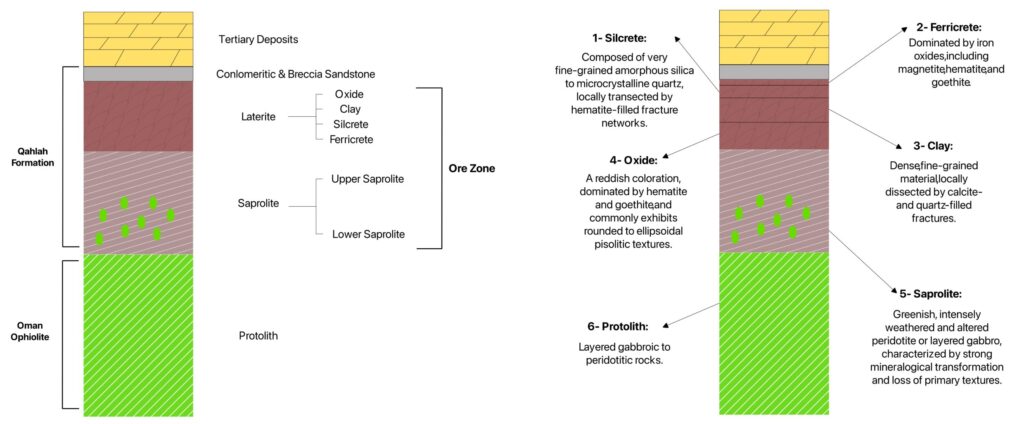
Laterite deposits in Oman display a well-developed vertical weathering profile that reflects progressive chemical alteration of ultramafic and mafic protoliths of the Semail Ophiolite under prolonged subaerial exposure. The laterite profile results from intense leaching of mobile elements (Mg, Ca, Na, Si) and residual concentration of relatively immobile elements, particularly Fe, Al, Ni, Co, and Mn. Although profile thickness and completeness vary according to lithology, topography, drainage, and duration of weathering, a broadly consistent zonation can be recognized across laterite occurrences in the Oman Mountains.
1. Protolith
The basal zone of the laterite profile consists of fresh to slightly weathered ultramafic or mafic bedrock, typically serpentinized harzburgite and dunite, and locally layered gabbro. Primary mineral assemblages include olivine, orthopyroxene, clinopyroxene, chromite, and serpentine minerals. Chemical weathering at this level is limited, and primary textures and structures are well preserved. Nickel and cobalt contents in this zone generally reflect background concentrations inherited from the parent rock and show minimal enrichment.
2. Saprolitic Zone (Silicate Zone)
Overlying the fresh bedrock is the saprolitic zone, which represents the most chemically altered part of the profile while still preserving relict textures of the protolith. In Oman, this zone is particularly well developed over serpentinized ultramafic rocks and may reach thicknesses of several meters to locally more than ten meters in favorable geomorphological settings. The saprolite is characterized by the breakdown of primary silicate minerals and the formation of secondary hydrous Mg-silicates such as serpentine, talc, chlorite, and locally Ni-bearing phases (e.g., nepouite and willemseite). This zone commonly hosts the highest nickel concentrations in silicate-type (Type A) laterites, with Ni values typically ranging from 0.5 to >1.0 wt.% Ni in some profiles. The enrichment of Ni is controlled by substitution into secondary silicates and adsorption onto clay minerals formed during weathering.
3. Oxide Zone (Limonitic Zone)
Nickel and cobalt in this zone are typically incorporated into goethite and Mn-oxide phases by adsorption or structural substitution. In Oman, oxide-type laterites commonly contain 0.3–0.8 wt.% Ni, with cobalt locally enriched relative to nickel. This zone is particularly important in profiles developed under good drainage and more oxidizing conditions, where downward leaching of Ni from the oxide zone may also contribute to enrichment in the underlying saprolite. Nickel and cobalt in this zone are typically incorporated into goethite and Mn-oxide phases by adsorption or structural substitution. In Oman, oxide-type laterites commonly contain 0.3–0.8 wt.% Ni, with cobalt locally enriched relative to nickel. This zone is particularly important in profiles developed under good drainage and more oxidizing conditions, where downward leaching of Ni from the oxide zone may also contribute to enrichment in the underlying saprolite.
4. Ferricrete / Lateritic Cap
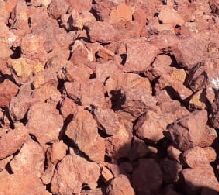
The uppermost part of the profile consists of a ferricrete or lateritic duricrust, formed by cementation of iron oxides and hydroxides into a hard, indurated layer. This horizon is typically reddish-brown to dark brown, highly resistant to erosion, and may contain pisolitic or nodular textures.
Although metal grades in the ferricrete are generally lower than in the saprolitic and oxide zones, this horizon plays a critical role in preserving the underlying laterite profile by protecting it from erosion. Locally, manganese oxides and secondary iron enrichment may enhance the metal content of this zone.
5. Soil and Clay-Rich Horizon (Local)
In some areas, a thin clay-rich soil horizon overlies the ferricrete, particularly where lateritic profiles have been reworked or partially eroded. This horizon may include kaolinite, smectite, and reworked iron oxides, reflecting ongoing weathering and surface processes.
Exploration
Exploration for laterite deposits in Oman is fundamentally controlled by geological understanding of ultramafic protolith distribution, degree of serpentinization, structural architecture, and geomorphological evolution within the Semail Ophiolite. The first exploration priority is detailed lithological discrimination between harzburgite-, dunite-, and gabbro-dominated sequences, as nickel fertility is strongly influenced by the primary mineral composition of the mantle section. Dunite-rich zones, particularly those with higher primary olivine content, may provide more favorable nickel sources during lateritization compared to pyroxene-dominated harzburgites. Therefore, high-resolution geological mapping is essential to delineate ultramafic domains and identify the most prospective protoliths.
The degree of serpentinization is another critical geological factor. Serpentinization enhances permeability, fracture density, and fluid circulation pathways, which in turn promote deeper and more effective chemical weathering. Highly serpentinized ultramafic bodies are therefore prime targets, as they allow meteoric fluids to penetrate to greater depths, facilitating magnesium and silica leaching and residual nickel enrichment. Exploration programs should carefully document structural fabrics, fracture networks, shear zones, and fault systems, since these features locally increase weathering intensity and may control the thickness and grade distribution of lateritic profiles.
Vertical geological profiling is central to exploration success. Laterite deposits must be evaluated as complete weathering systems rather than surface anomalies. Geological logging of trenches and drill cores should document the transition from fresh ultramafic bedrock to saprolite, transitional zones, limonite horizons, and ferricrete caps. Particular attention should be given to textural preservation within the saprolite zone, where primary rock fabrics may still be visible despite mineralogical replacement. The saprolite–bedrock interface is often a key zone for nickel enrichment in silicate-type laterites, whereas limonite horizons may host adsorbed or structurally incorporated nickel and cobalt within iron oxyhydroxides.
Stratigraphically, exploration must consider the relationship between lateritic development and the overlying Qahlah Formation. In some areas, remnants of ferruginous horizons or reworked lateritic material within the Qahlah Formation provide indirect evidence of earlier weathering intensity. Understanding the paleosurface geometry and erosional history is therefore important for predicting preserved laterite thickness. Areas that remained geomorphologically stable after obduction are more likely to retain thick, economically significant profiles, whereas uplifted or deeply eroded zones may host only thin or truncated remnants.
Geochemical exploration should be interpreted within a geological framework rather than treated as isolated data. Nickel enrichment must be evaluated relative to MgO depletion, Fe enrichment, and silica mobility trends within the vertical profile. Element ratios such as Ni/Mg and Fe/Si can help distinguish residual enrichment from transported or reworked material. In addition, cobalt distribution commonly reflects redox conditions within the limonite zone and may provide insights into paleo-oxidation fronts within the weathering column.
Drilling programs should be designed to test geological continuity of the weathering profile rather than simply confirming surface grades. Because Omani laterites commonly occur as discontinuous caps controlled by paleotopography, drill grids must account for potential lateral thinning and structural truncation. Cross-sections constructed from geological logging are essential to model saprolite thickness, limonite development, and bedrock topography. Accurate geological modeling allows better estimation of resource geometry and identification of higher-grade saprolitic cores within broader lower-grade halos.
In summary, geological exploration of laterite deposits in Oman requires integrated analysis of ultramafic lithology, serpentinization intensity, structural controls, vertical weathering architecture, stratigraphic relationships, and geomorphological stability. Successful targeting depends on recognizing that nickel enrichment is a function of protolith composition, duration of chemical weathering, and preservation of the weathering profile within the tectonic and erosional history of the Oman Mountains.