
Overview
Manganese (Mn) is a critical industrial metal, indispensable for steel production, alloy manufacturing, battery technologies, and chemical applications. Its capacity to improve hardness, wear resistance, and corrosion resistance in steel, combined with its chemical versatility, makes it a globally strategic metal. In recent years, high-purity manganese has also gained importance in the production of lithium-ion batteries and other energy storage technologies, enhancing its economic relevance.
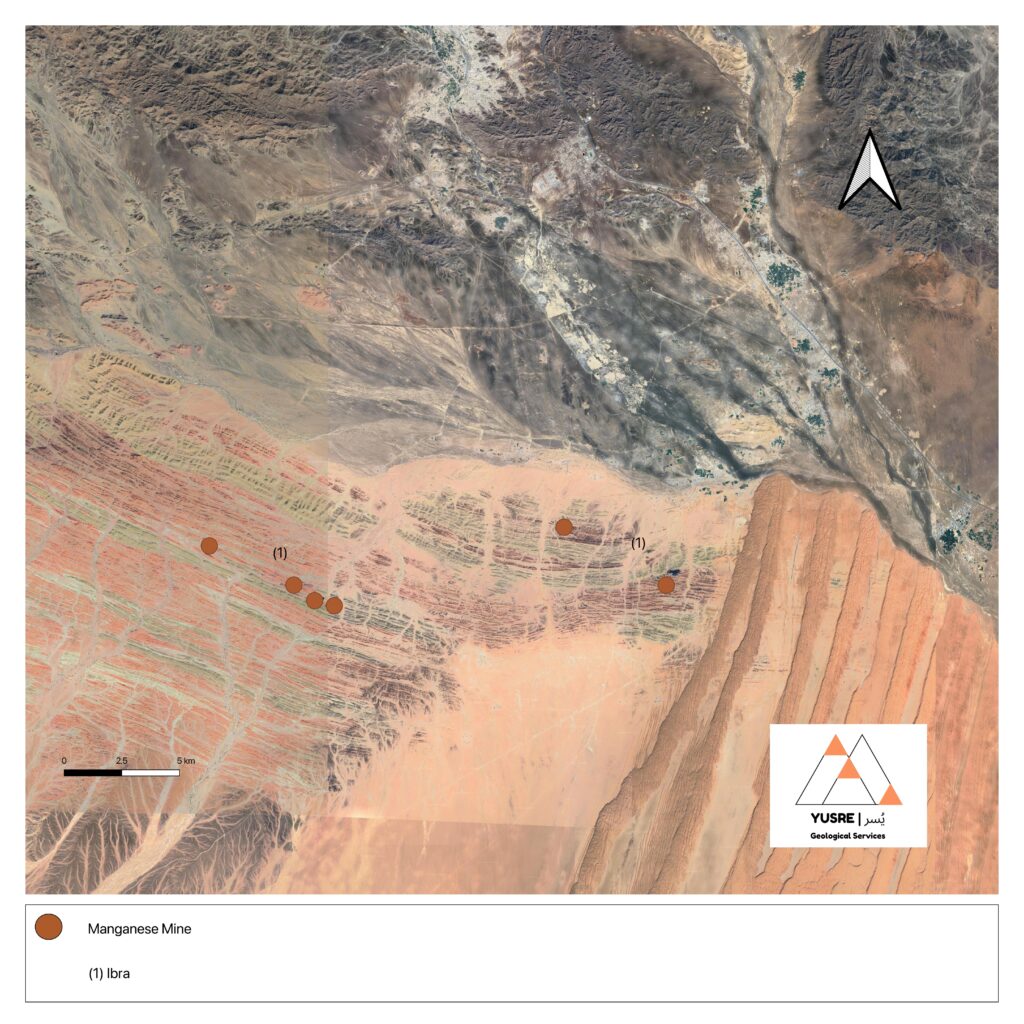
In Oman, manganese mineralization is predominantly hosted within the Wahrah Formation, a Permian-Triassic sedimentary sequence exposed in the northern Oman Mountains. The Wahrah Formation consists of interlayered carbonate, chert, and siliciclastic units, which provided suitable chemical and physical conditions for the deposition of manganese oxides and hydroxides during early diagenesis. Manganese occurs as stratiform beds, lensoidal accumulations, and nodular concentrations, often associated with iron oxides such as hematite and goethite. The mineralization reflects a combination of chemical precipitation in shallow marine environments and localized enrichment through post-depositional remobilization, weathering, and minor hydrothermal processes.
Ore zones within the Wahrah Formation exhibit considerable variability in thickness, lateral continuity, and grade. High-grade lenses can contain up to 45–55% Mn, while lower-grade zones may average 35–40% Mn, depending on the degree of enrichment and alteration. These manganese deposits are frequently lateritized at surface, forming oxidized caps rich in pyrolusite, psilomelane, and manganite, which are suitable for both metallurgical and chemical uses. The combination of stratigraphic control, lithological variation, and tectonic influence has created manganese bodies that range from a few meters to tens of meters thick, with lateral extensions from tens to hundreds of meters.
From a structural perspective, manganese mineralization in the Wahrah Formation is controlled by subtle folding, faulting, and fracturing, which influenced fluid circulation and the redistribution of manganese during diagenesis and weathering. Alteration halos surrounding the manganese lenses are commonly enriched in iron oxides and exhibit oxidation patterns indicative of near-surface enrichment processes. The stratiform nature of the deposits, coupled with moderate tectonic disruption, facilitates predictable continuity, which is highly advantageous for exploration and potential resource development.
Historically, manganese in Oman was recognized through surface exposures and small-scale artisanal mining, but systematic geological mapping and modern geochemical surveys have significantly improved understanding of ore controls. Modern exploration emphasizes field mapping, sampling, geochemical tracing, and spectroscopic methods to identify oxide-rich zones and delineate potential targets within the Wahrah Formation. These investigations highlight the strategic potential of Omani manganese as a supplementary industrial resource, particularly in regional steel production and emerging battery applications.
Deposit Profile
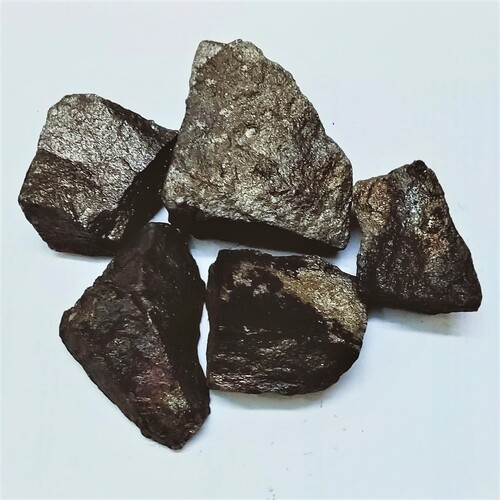
Primary Commodity:
Manganese (Mn)
Associated Commodities:
Iron (Fe); locally minor cobalt (Co) and trace nickel (Ni) in some horizons
Deposit Type:
– Stratiform sedimentary manganese deposits
– Locally supergene-enriched and lateritic manganese accumulations
– Minor structurally controlled remobilized lenses
Host Rocks:
– Carbonate, chert, marl, and siliciclastic units of the Wahrah Formation
– Locally associated with iron-rich horizons and siliceous layers
Tectonic Setting:
– Passive continental margin to shallow marine sedimentary environment during Permian–Triassic time
– Subsequently affected by deformation during obduction of the Oman Ophiolite
Ore Minerals:
Pyrolusite (MnO₂)
Psilomelane
Cryptomelane
Manganite
Minor braunite in some horizons
Gangue Minerals:
Calcite
Dolomite
Chert (microcrystalline silica)
Hematite and goethite
Clay minerals
Alteration Style:
– Primary chemical sedimentary precipitation
– Supergene oxidation and secondary enrichment
– Lateritic enrichment at surface
– Minor remobilization along fractures and fault zones
Structural Controls:
– Stratigraphic control within specific Wahrah Formation horizons
– Local enhancement along fractures, faults, and fold hinges
– Secondary enrichment along permeable bedding planes
Mineralization Style:
– Stratiform and bedded manganese layers
– Lensoidal accumulations
– Nodular and concretionary manganese concentrations
– Lateritic surface caps
Typical Grades:
– Manganese: ~35–55% Mn depending on enrichment
– Iron: Variable, commonly 5–15% Fe
Deposit Scale:
– Small to medium-sized deposits
– Lens thickness typically a few meters to tens of meters
– Lateral continuity from tens to hundreds of meters
Exploration Status:
– Historically identified through surface mapping and small-scale extraction
– Modern exploration involves detailed mapping, trenching, geochemical sampling, and drilling within Wahrah Formation exposures
– Several occurrences remain partially explored with potential for resource expansion
Geological Setting
Manganese mineralization in Oman is primarily associated with the Wahrah Formation, a Permian–Triassic sedimentary succession exposed in the northern Oman Mountains. The Wahrah Formation forms part of the autochthonous to para-autochthonous sedimentary cover beneath and adjacent to the obducted Oman Ophiolite. It consists predominantly of shallow marine carbonates, chert horizons, marl, and subordinate siliciclastic units deposited along a passive continental margin setting prior to ophiolite emplacement.
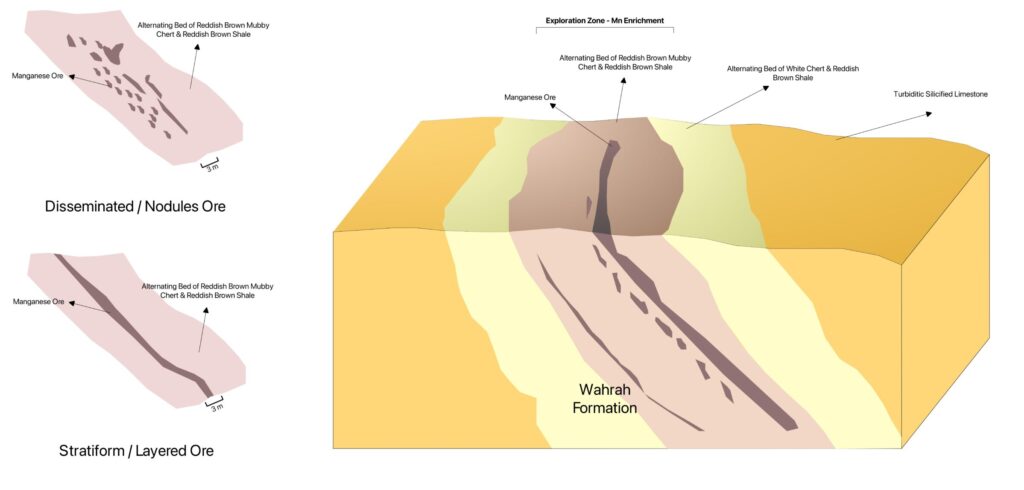
During the Late Permian to Early Triassic, the region was characterized by shallow epicontinental seas with fluctuating redox conditions. These conditions were favorable for the chemical precipitation of manganese and iron oxides from seawater. Manganese was likely derived from hydrothermal input at distal spreading centers, continental weathering, and basin-scale seawater circulation. Periodic changes in oxygenation levels within the marine basin promoted manganese enrichment in specific stratigraphic horizons, leading to the development of stratiform manganese beds interlayered with carbonates and siliceous sediments.
The manganese mineralization is strongly stratigraphically controlled, occurring within discrete horizons of the Wahrah Formation. These horizons are commonly associated with chert-rich or marl-bearing intervals that provided suitable geochemical traps for manganese precipitation. Fine lamination, nodular textures, and bedded oxide layers suggest primary sedimentary deposition followed by early diagenetic modification.
Subsequent tectonic events significantly influenced the present distribution of manganese deposits. During the Late Cretaceous obduction of the Oman Ophiolite, the sedimentary sequences of the Wahrah Formation were subjected to folding, faulting, and uplift. These tectonic processes fractured the host rocks and locally enhanced fluid circulation, leading to minor remobilization and secondary enrichment of manganese along structural zones. In some areas, surface weathering and supergene processes further concentrated manganese oxides, forming lateritic caps and high-grade surface accumulations.
Lithologically, the host rocks display interbedded carbonate and siliceous units with varying permeability. The presence of chert layers and microfractured carbonate beds facilitated localized fluid movement and secondary enrichment. Iron oxides such as hematite and goethite are commonly associated with manganese mineralization, reflecting similar geochemical precipitation mechanisms under oxidizing conditions.
Regionally, manganese occurrences are distributed along structurally deformed belts where the Wahrah Formation is well exposed. The combination of favorable sedimentary facies, stratigraphic trapping mechanisms, and post-depositional tectonic modification created the geological framework responsible for manganese concentration in Oman.
Overall, the geological setting of Omani manganese deposits reflects a sedimentary-chemical origin within shallow marine environments, later modified by tectonic deformation and surface weathering processes. This integrated stratigraphic and structural control provides a predictable exploration model focused on specific Wahrah Formation horizons and structurally enhanced zones.
Ore Mineralogy
The manganese deposits of Oman, principally hosted within the Wahrah Formation, are characterized by a predominance of manganese oxides and hydroxides formed through primary marine chemical precipitation and subsequently modified by diagenetic and supergene processes. The mineral assemblage reflects deposition in shallow marine environments under fluctuating redox conditions, followed by tectonic uplift and prolonged surface weathering. As a result, most economically significant manganese occurrences in Oman are oxide-rich rather than sulphide-bearing, with mineralogical variations closely tied to stratigraphic position and degree of post-depositional alteration.
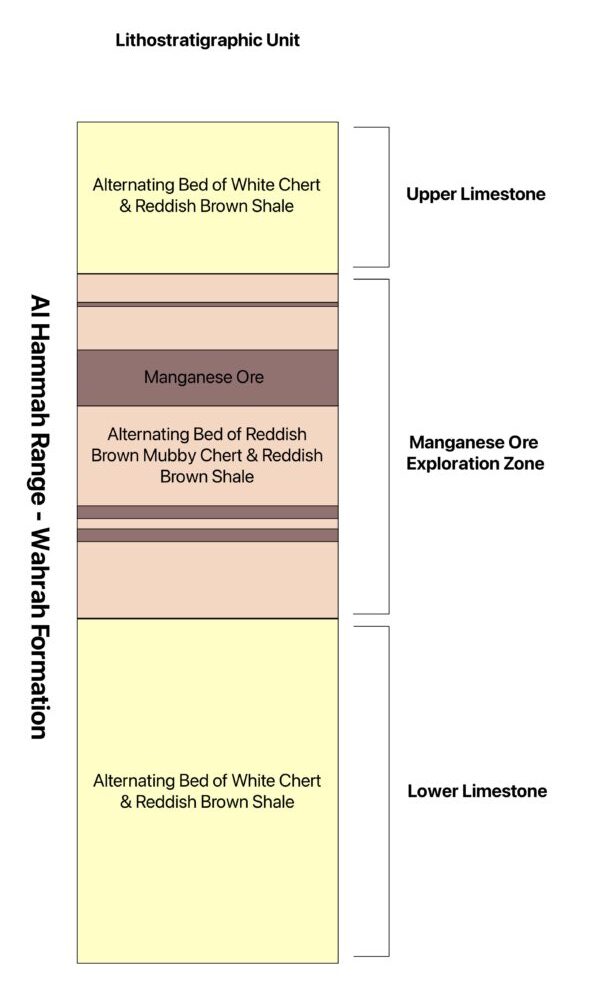
The dominant ore mineral is pyrolusite (MnO₂), which commonly represents the highest manganese-grade phase within the deposits. Pyrolusite occurs as massive fine-grained aggregates, compact stratiform layers, botryoidal crusts, and fracture-filling material. In many cases, it forms through the oxidation of earlier manganese-bearing minerals during supergene enrichment, particularly near surface exposures. Its presence is typically associated with well-developed oxidation zones, where meteoric waters have enhanced manganese concentration by leaching and redeposition. The abundance of pyrolusite directly influences the overall grade of the ore, especially in enriched horizons.
Psilomelane, a field term commonly applied to hard, massive barium-bearing manganese oxides such as cryptomelane-group minerals, is also widespread and contributes substantially to bulk ore composition. It typically forms dense, steel-grey to black compact masses, nodules, and layered accumulations within stratiform beds. Cryptomelane (KMn₈O₁₆) frequently occurs as microcrystalline aggregates intergrown with pyrolusite, particularly in oxidized and potassium-enriched zones. These minerals are indicative of supergene processes and secondary mineral stabilization under oxidizing surface conditions.
Manganite (MnO(OH)) occurs locally in less intensely oxidized sections and may represent either an early diagenetic precipitate or an intermediate phase in the transformation from primary manganese carbonate or silicate phases to stable oxides. It is typically observed as prismatic crystals or granular masses within bedded manganese horizons. In certain siliceous intervals, braunite (Mn²⁺Mn³⁺₆SiO₁₂) may be present, especially where silica activity was elevated during diagenesis. Braunite-bearing zones are generally more compact and may indicate primary sedimentary chemical precipitation under specific basin conditions.
Iron oxides such as hematite (Fe₂O₃) and goethite (FeO(OH)) are common accessory minerals and frequently occur interbedded with manganese oxides or as replacement phases within carbonate host rocks. Their presence reflects similar redox-controlled precipitation mechanisms and indicates periodic variations in basin oxygenation. Gangue minerals are predominantly calcite, dolomite, microcrystalline silica (chert), and clay minerals, with carbonate units often showing partial replacement by manganese oxides. Chert-rich intervals within the Wahrah Formation are particularly significant, as they commonly coincide with manganese-rich horizons, suggesting a strong geochemical link between silica precipitation and manganese concentration.
Texturally, the deposits display well-developed stratiform and laminated bedding, nodular and concretionary structures, botryoidal and colloform oxide growth patterns, and localized fracture-filling mineralization. Replacement textures within carbonate beds are also common, indicating post-depositional fluid interaction and secondary enrichment. Overall, the ore mineralogy supports a model of primary chemical sedimentation in a shallow marine setting, subsequently enhanced by diagenetic redistribution and supergene oxidation, which together produced economically viable manganese concentrations in Oman.
Sur Deposits
Manganese deposits in the Sur area of eastern Oman constitute a small but geologically significant group of stratiform manganese occurrences developed within deep-marine sedimentary sequences associated with the Hawasina Complex and the eastern margin of the Semail Ophiolite. The Sur region occupies a structurally complex zone where oceanic sediments, ophiolitic units, and post-obduction deformation intersect, creating favorable conditions for chemical sedimentation and metal concentration during the evolution of the Neotethyan ocean basin. The manganese mineralization in the Sur area is primarily hosted by siliceous sedimentary rocks, including radiolarian chert, siliceous shale, and locally marly or calcareous interbeds. These lithologies are typical of distal deep-marine depositional environments and are comparable to manganese-bearing horizons documented within the Wahrah Formation in northern Oman. Mineralization generally occurs as thin stratiform layers, discontinuous lenses, or disseminated impregnations concordant with bedding, rather than as vein-type or structurally controlled bodies.
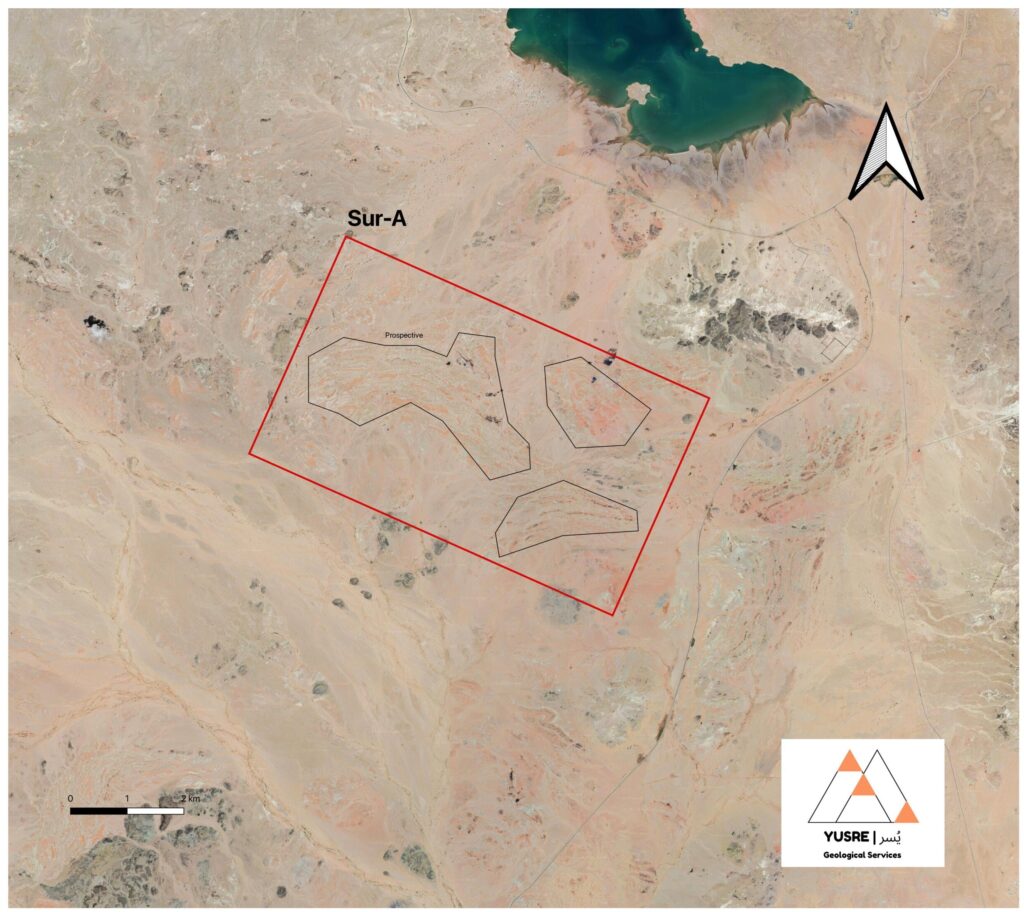
Available field observations, historical sampling, and limited geochemical analyses indicate that manganese grades in the Sur area are moderate to locally high, but highly variable over short distances. Reported MnO contents from surface and near-surface samples typically range between 10 and 35 wt.% MnO, with localized enrichments exceeding 40 wt.% MnO in small lenses or pockets where manganese oxides are concentrated. Average grades over continuous horizons are generally lower, commonly in the range of 12–25 wt.% MnO, reflecting dilution by silica and clay-rich host rocks. Iron contents are typically low to moderate, resulting in high Mn/Fe ratios, a characteristic feature of sedimentary and hydrogenous manganese deposits. This geochemical signature supports selective manganese precipitation under oxic to suboxic conditions at or near the sediment–water interface. Silica (SiO2) contents are commonly high, often exceeding 50–70 wt.%, due to the dominance of radiolarian chert as the host lithology, which has a direct impact on bulk ore grade and beneficiation potential. Trace element concentrations, where analyzed, show generally low levels of base metals such as Cu, Zn, Ni, and Co, distinguishing the Sur manganese occurrences from hydrothermal or volcanogenic massive sulfide–related systems. Barium may be locally enriched, particularly in association with siliceous horizons, suggesting episodic changes in seawater chemistry or minor low-temperature hydrothermal input.
Individual manganese horizons in the Sur area are typically thin, ranging from a few centimeters up to 0.3–1.0 m in thickness, and laterally persistent over tens to a few hundreds of meters. Based on surface mapping and limited continuity, individual occurrences are interpreted to contain small tonnages, commonly on the order of several thousand to tens of thousands of tonnes per horizon. No large, laterally extensive manganese bodies comparable to major global sedimentary manganese deposits have been documented in the Sur area to date. As a result, these occurrences are best classified as small stratiform manganese deposits or prospects, rather than defined economic deposits. However, their significance lies in their consistency with regional manganese-bearing stratigraphy and their potential to occur as multiple stacked horizons within favorable sedimentary packages.
The manganese deposits of the Sur area are interpreted to have formed predominantly through sedimentary to hydrogenous processes, driven by redox-controlled precipitation of manganese from seawater in a deep-marine basin. Fluctuations in oxygen availability, biological productivity, and sedimentation rates likely governed the episodic formation of manganese-rich layers. Minor hydrothermal contribution cannot be ruled out, particularly given the proximity to ophiolitic volcanic units, but available evidence suggests it played a secondary role. Although the Sur manganese deposits are currently of limited economic importance, they provide valuable insights into the behavior of manganese in ophiolite-related basins and serve as useful analogues to Wahrah Formation deposits elsewhere in Oman. From an exploration perspective, they highlight the importance of targeting siliceous deep-marine stratigraphy, high Mn/Fe ratios, and laterally persistent chert horizons when assessing manganese potential in eastern Oman.