
Overview
Gypsum deposits in Oman are sedimentary evaporite accumulations formed under arid to semi-arid climatic conditions within restricted marine basins. Unlike laterite systems that develop through subaerial weathering of ultramafic rocks, gypsum forms by chemical precipitation from saline waters during evaporation. In Oman, major gypsum deposits are primarily associated with the Umm Er Radhuma Formation and the Rus Formation, both of which were deposited on the Arabian carbonate platform during the Paleocene–Eocene. These formations record periods of restricted marine circulation where high evaporation rates exceeded freshwater inflow, leading to supersaturation of calcium sulfate and the precipitation of gypsum (CaSO₄·2H₂O).
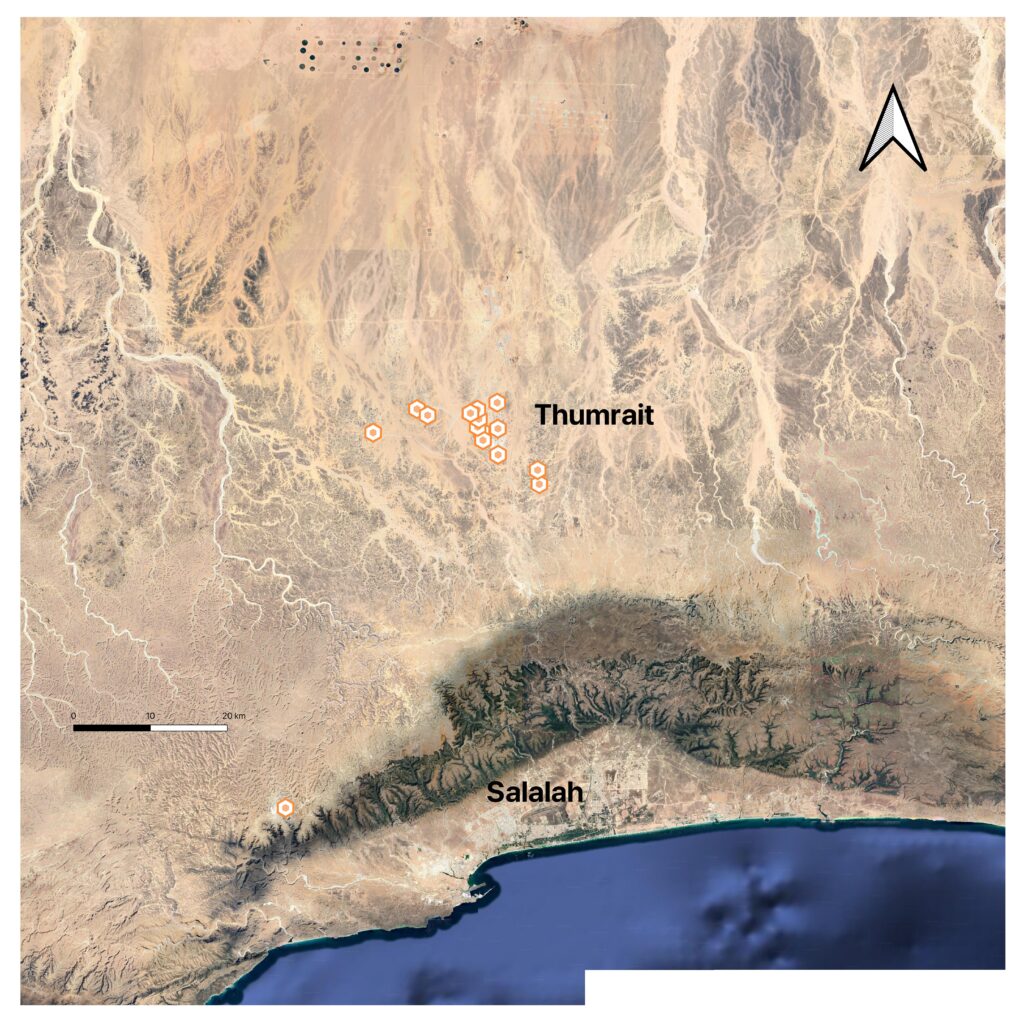
The tectonic framework of Oman during the Paleogene was characterized by relative stability following the obduction of the Semail Ophiolite. The region formed part of a broad, shallow epicontinental sea on the Arabian Plate, where periodic restriction of marine waters created ideal conditions for evaporite deposition. Fluctuations in sea level, basin restriction, and climate controlled the thickness and lateral extent of gypsum horizons. Repeated cycles of marine transgression and regression produced layered evaporitic sequences interbedded with limestone, dolomite, and marl, reflecting alternating normal marine and hypersaline conditions.
Stratigraphically, gypsum typically occurs as bedded or massive horizons within carbonate-dominated successions. In the Rus Formation, thick gypsum beds are interlayered with dolomitic limestones and marls, indicating deposition in shallow, restricted lagoons or sabkha environments. Primary depositional textures may include laminated gypsum, nodular gypsum, and enterolithic structures formed by early diagenetic deformation. In some cases, original anhydrite (CaSO₄) may have formed at depth under higher temperature and pressure conditions and was later hydrated to gypsum during uplift and exposure. This hydration process can significantly influence deposit texture and mechanical properties.
Vertical variation within gypsum-bearing sequences reflects changes in salinity and water depth. Lower portions of evaporite cycles may begin with carbonate deposition, followed by gypsum precipitation as evaporation intensifies, and potentially halite deposition under extreme salinity. However, in Oman, gypsum is more common than thick halite accumulations, indicating moderate to strong evaporation but not always extreme basin desiccation. The thickness of individual gypsum beds can range from a few meters to several tens of meters, depending on basin geometry and duration of evaporitic conditions.
Structurally, gypsum deposits may be influenced by gentle folding, faulting, and dissolution processes. Because gypsum is relatively soluble compared to carbonates, secondary features such as collapse structures, cavities, and karst-like voids may develop due to groundwater dissolution. These processes can locally modify thickness and continuity. Nevertheless, many Omani gypsum deposits display strong lateral continuity over large areas, making them attractive for industrial-scale extraction.
Geographically, significant gypsum resources occur in northern and central Oman, particularly within Paleogene sedimentary basins where evaporitic sequences are well exposed. The deposits are typically shallow, laterally extensive, and amenable to open-pit mining. From a metallogenic perspective, gypsum in Oman represents a classic platform-evaporite system formed through chemical sedimentation in restricted marine environments under arid climatic conditions.
Main Points
– Deposit Type: Sedimentary evaporite (chemical precipitation).
– Regional Framework: Arabian Plate carbonate platform during Paleocene–Eocene time.
– Tectonic Context: Post-ophiolite obduction stable platform setting.
– Host Formations: Rus Formation and Umm Er Radhuma Formation.
– Depositional Environment: Restricted shallow marine lagoons and sabkha systems under arid climate.
– Formation Process: Evaporation of sulfate-rich seawater leading to gypsum precipitation; locally anhydrite hydration.
– Stratigraphic Style: Bedded to massive gypsum interlayered with limestone, dolomite, and marl.
– Structural Influence: Minor folding and faulting; local dissolution and collapse features.
– Economic Significance: Laterally extensive, shallow deposits suitable for open-pit mining and industrial use.
Deposit Profile
Primary Commodity:
Gypsum (CaSO₄·2H₂O)
Associated Commodities:
Anhydrite (CaSO₄); locally minor limestone and dolomite
Deposit Type:
Sedimentary evaporite deposit
Bedded to massive gypsum horizons
Locally secondary gypsum derived from hydration of anhydrite
Host Rocks:
Carbonate and evaporite sequences of the Rus Formation
Carbonate platform units of the Umm Er Radhuma Formation
Interbedded limestone, dolomite, and marl
Tectonic Setting:
Stable Arabian Plate carbonate platform during Paleocene–Eocene
Post-obduction passive margin conditions following emplacement of the Semail Ophiolite
Ore Minerals:
Gypsum (CaSO₄·2H₂O)
Anhydrite (CaSO₄)
Gangue Minerals:
Calcite
Dolomite
Marl (clay-carbonate mixture)
Minor clay minerals
Alteration Style:
Primary chemical precipitation from evaporating seawater
Diagenetic recrystallization
Hydration of anhydrite to gypsum during uplift and exposure
Local dissolution and re-precipitation
Structural Controls:
Stratigraphic control within evaporitic horizons
Gentle folding and minor faulting
Local thickness variation due to dissolution or collapse
Mineralization Style:
Laterally extensive bedded gypsum layers
Massive gypsum units
Nodular and laminated evaporite textures
Enterolithic (folded) gypsum structures
Typical Grades / Purity:
High-purity gypsum commonly >85–95% CaSO₄·2H₂O
Low silica and low carbonate impurities in economic zones
Deposit Scale:
Large, laterally continuous sedimentary bodies
Thickness from a few meters to several tens of meters
Regional-scale evaporite basins
Geological Setting
The Rus Formation represents one of the most significant Paleogene evaporitic successions developed along the Arabian Plate, and in Oman it forms a regionally extensive stratigraphic unit deposited during the Early Eocene. Following the Late Cretaceous obduction of the Semail Ophiolite, the northern Oman Mountains underwent progressive tectonic stabilization, subsidence, and marine transgression. This transition from an active obduction margin to a relatively stable passive-margin carbonate platform created ideal conditions for shallow marine sedimentation. During the Early Eocene, broad, restricted epicontinental basins developed across northern and central Oman, where high evaporation rates under arid climatic conditions led to the precipitation of thick evaporitic sequences that now define the Rus Formation.
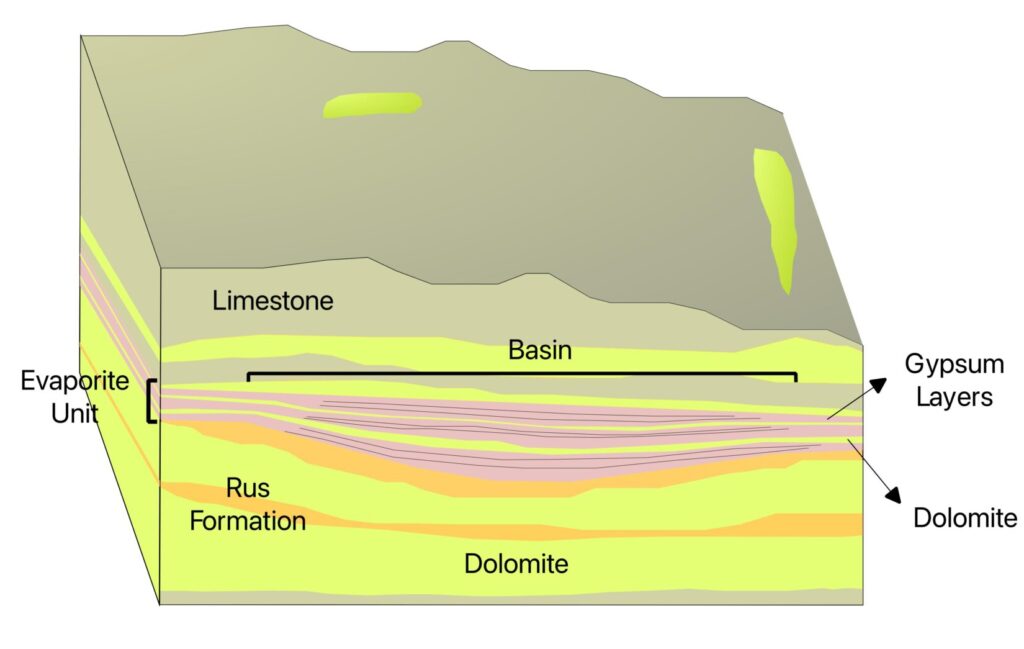
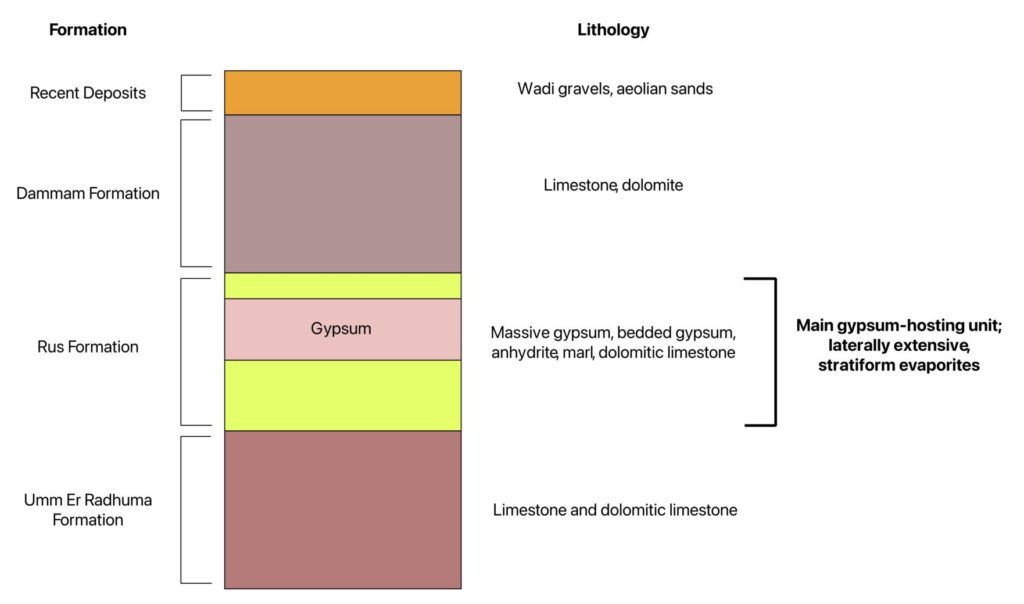
Stratigraphically, the Rus Formation conformably overlies the Paleocene carbonate platform deposits of the Umm Er Radhuma Formation and is typically overlain by younger Eocene carbonates such as the Dammam Formation. The formation is dominated by gypsum and anhydrite, interbedded with limestone, dolomite, and marl. These lithological associations reflect fluctuating depositional conditions within restricted lagoons, tidal flats, and shallow subtidal environments. Periodic marine incursions introduced normal seawater into the basin, followed by intense evaporation that concentrated brines and triggered the chemical precipitation of calcium sulfate minerals. Repeated cycles of flooding and evaporation produced bedded, laminated, nodular, and massive gypsum horizons, commonly exhibiting enterolithic folding and chicken-wire textures indicative of early diagenetic growth within semi-consolidated sediments.
The formation process of the Rus evaporites is fundamentally linked to climatic and eustatic controls. During the Early Eocene, the Arabian Plate was situated in a subtropical to arid belt, where evaporation significantly exceeded precipitation. Restricted basin geometry, combined with limited water circulation, allowed seawater to become progressively concentrated. As salinity increased, carbonate minerals precipitated first, followed by gypsum and eventually anhydrite under higher temperatures and salinity levels. In many areas of Oman, primary anhydrite later underwent hydration during uplift and exposure, converting to secondary gypsum. This hydration process often caused volume expansion, fracturing, and local brecciation, contributing to the massive and nodular textures observed today.
Structurally, the Rus Formation is relatively undeformed compared to older tectonically emplaced units such as the Semail Ophiolite. However, gentle folding, minor faulting, and dissolution-related collapse structures are locally present, particularly along the flanks of the Oman Mountains. The soluble nature of gypsum makes the formation susceptible to karstification, sinkhole development, and secondary porosity enhancement. These post-depositional processes influence both the geomorphology and the economic characteristics of the deposits.
Regionally, the Rus Formation forms laterally continuous evaporite bodies extending across northern Oman and into neighboring Gulf countries, indicating deposition within a broad, interconnected evaporitic system on the Arabian Platform. In Oman, the formation is especially important as a major source of industrial gypsum, with thick, high-purity horizons suitable for cement production, plaster manufacturing, and other construction-related industries. Its geological significance lies not only in its economic value but also in its role as a key marker of Paleogene paleoclimate, basin restriction, and post-obduction stabilization of the Arabian continental margin.
Ore Mineralogy
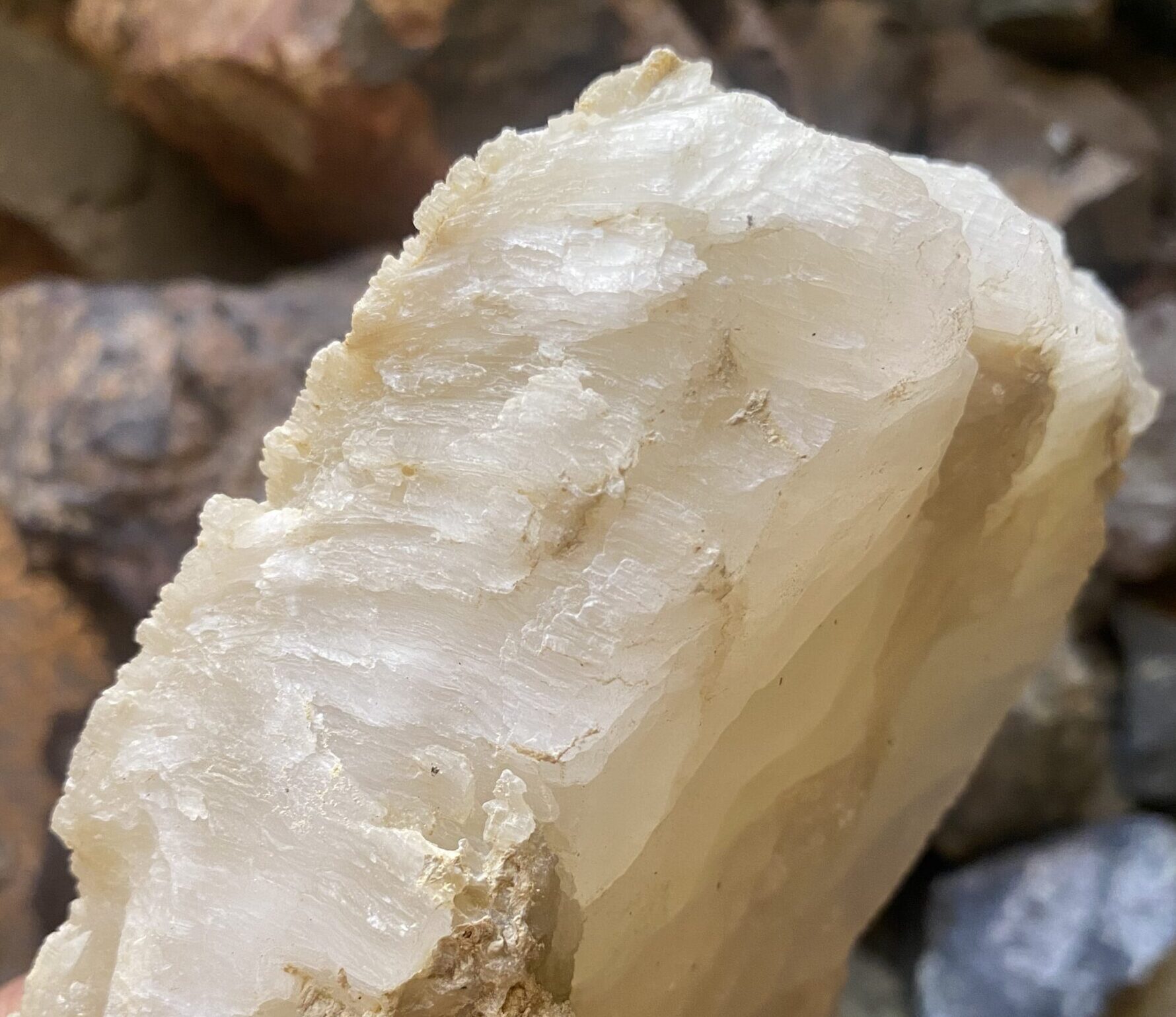
The ore mineralogy of the Rus Formation is dominated by calcium sulfate minerals formed through evaporitic precipitation in restricted marine basins during the Early Eocene. The principal economic mineral is gypsum (CaSO₄·2H₂O), which occurs in thick, laterally continuous bedded units as well as in massive, nodular, laminated, and enterolithic forms. Gypsum typically appears as fine- to medium-grained crystalline aggregates, though selenite varieties with coarse, transparent crystals may locally develop in secondary cavities or along fractures. The purity of gypsum in many Omani deposits is high, commonly exceeding 85–95% CaSO₄·2H₂O, making it suitable for industrial applications such as cement retarders, plaster production, and wallboard manufacturing.
Anhydrite (CaSO₄) is also an important primary mineral within the Rus Formation. In many cases, anhydrite originally precipitated under higher salinity and temperature conditions within the evaporitic basin. Subsequent uplift, meteoric water infiltration, and exposure led to widespread hydration of anhydrite into secondary gypsum. This transformation is commonly accompanied by volume expansion, fracturing, and the development of brecciated or nodular textures. In some deeper or less-altered sections, remnant anhydrite may still be preserved, indicating incomplete hydration and providing insight into the original depositional conditions.
Associated gangue minerals mainly include calcite and dolomite, reflecting periodic influxes of normal marine carbonate sedimentation during less evaporitic phases. Marl and minor clay minerals may occur as thin interbeds, representing quieter depositional intervals or continental input. Silica is generally low in high-grade zones but may be present as minor detrital quartz. Iron oxides can locally stain gypsum beds, especially near surface exposures where oxidation processes have occurred. However, sulfide minerals are generally absent, consistent with the chemical sedimentary origin of the deposit rather than hydrothermal mineralization.
Texturally, the ore exhibits features typical of evaporitic environments, including laminated bedding from repeated evaporation cycles, chicken-wire and nodular structures formed during early diagenetic growth of sulfate minerals, and enterolithic folding caused by differential compaction and expansion. These textures are important indicators of depositional and diagenetic history and help distinguish primary evaporitic gypsum from secondary or replacement varieties.
Overall, the ore mineralogy of the Rus Formation reflects a stable, shallow marine evaporitic system controlled by climatic aridity and basin restriction. The dominance of chemically precipitated calcium sulfate minerals, combined with low impurity content in economic zones, makes the formation one of the most significant industrial gypsum resources in Oman.
References
The following references provide the regional stratigraphic, sedimentological, tectonic, and economic framework necessary for understanding gypsum deposits within the Rus Formation and the broader Paleogene evaporite systems of Oman.
– Glennie, K. W., Boeuf, M. G. A., Clarke, M. W. H., Moody-Stuart, M., Pilaar, W. F. H., & Reinhardt, B. M. (1974). Geology of the Oman Mountains. Royal Dutch Shell, The Hague.
– Searle, M. P. (1988). Ophiolites and Oceanic Crust. Blackie & Son Ltd., Glasgow and London.
– Robertson, A. H. F., Searle, M. P., & Ries, A. C. (1990). The Geology and Tectonics of the Oman Region. Geological Society of London Special Publication.
– Alsharhan, A. S., & Nairn, A. E. M. (1997). Sedimentary Basins and Petroleum Geology of the Middle East. Elsevier, Amsterdam.
– Sharland, P. R., Archer, R., Casey, D. M., Davies, R. B., Hall, S. H., Heward, A. P., Horbury, A. D., & Simmons, M. D. (2001). Arabian Plate Sequence Stratigraphy. GeoArabia Special Publication.
– Warren, J. K. (2016). Evaporites: A Geological Compendium. Springer, Berlin.
– James, A. N. (1992). Hydrocarbon Exploration and Production in the United Arab Emirates. Journal of Petroleum Geology (for regional Paleogene stratigraphy comparison).