
Deposit Profile
Primary Commodity:
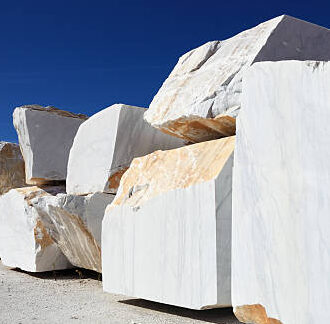
Marble (metamorphosed limestone and dolostone used as dimension stone)
Deposit Type:
Metamorphic carbonate (recrystallized limestone/dolostone)
Allochthonous tectonic blocks (Oman Exotics)
Dimension stone deposit
Geological Setting:
Structurally complex zone within the Hajar Mountains
Associated with emplacement of the Oman Ophiolite (Late Cretaceous obduction)
Carbonate blocks incorporated into tectonic mélange during thrust stacking
Host Rocks (Protolith):
Permian–Cretaceous shallow marine limestone
Dolostone (platform carbonates)
Shelf and reefal carbonate facies
Metamorphic Grade:
Low- to moderate-grade regional metamorphism
Recrystallization without extensive calc-silicate mineral development
Ore (Rock) Mineralogy:
Dominantly calcite (CaCO₃)
Locally dolomite (CaMg(CO₃)₂)
Minor accessory minerals (quartz, clay, iron oxides)
Secondary calcite veins along fractures
Texture and Fabric:
Granoblastic to equigranular crystalline mosaic
Medium- to coarse-grained calcite crystals
Partial preservation of relic bedding or fossil fragments (locally)
Veined and banded decorative varieties
Structural Controls:
Thrust faults and shear zones
Folded carbonate blocks
Fracture and joint systems controlling block size
Lens-shaped to tabular exotic carbonate bodies
Deposit Geometry:
Discrete tectonic blocks within mélange
Variable lateral continuity
Thickness ranges from tens to several hundreds of meters (block-dependent)
Quality Parameters (Dimension Stone):
Low fracture density (critical for large block extraction)
Uniform color and texture
High compressive strength
Low porosity
Minimal stylolitic or shear-related deformation
Extraction Method:
Surface quarrying (open-pit)
Block extraction using wire saws and controlled cutting
Economic Use:
Architectural stone
Flooring and cladding
Decorative slabs and tiles
Construction stone
Geological Setting
The marble deposits associated with the Oman Exotics occur within the structurally complex framework of the northern Oman Mountains, particularly in the Hajar Mountains. These deposits are genetically and spatially linked to the tectonic emplacement of the Oman Ophiolite during the Late Cretaceous obduction event, when oceanic lithosphere was thrust onto the northeastern margin of the Arabian Plate. This major tectonic episode fundamentally reshaped the paleogeography of northern Oman and played a central role in the structural dismemberment, transport, and preservation of carbonate sequences that now host marble bodies.
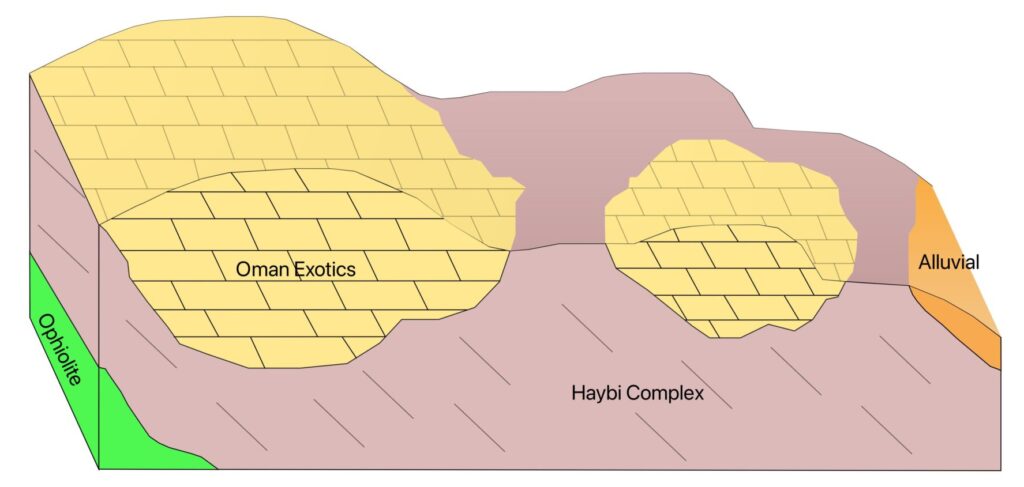
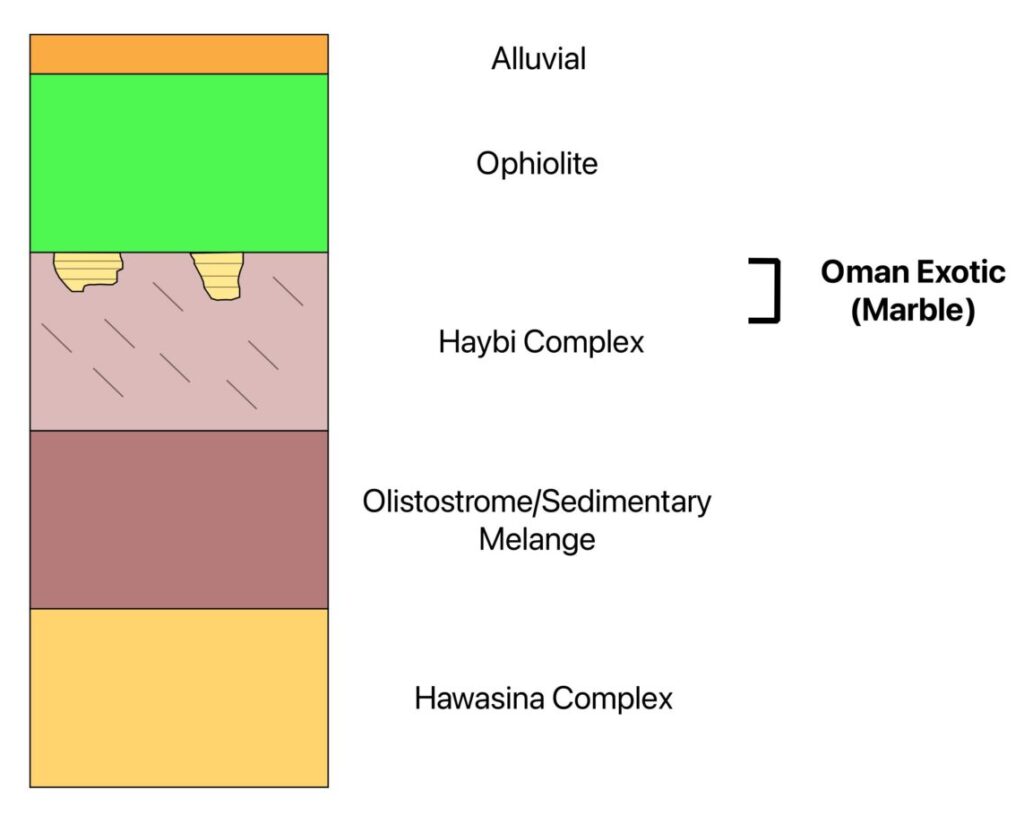
The Oman Exotics consist of allochthonous carbonate blocks and sedimentary fragments that were detached from the Arabian continental margin and incorporated into tectonic mélange during ophiolite emplacement. These exotic carbonate units range in age from Permian to Cretaceous and were originally deposited in shallow marine shelf and platform environments characterized by carbonate sedimentation, reef development, and bioclastic accumulation. During obduction and subsequent compressional tectonics, these carbonate sequences were tectonically transported, faulted, folded, and structurally interleaved with ultramafic rocks, radiolarites, and deep-marine sediments. The resulting tectonic architecture is highly heterogeneous, with discrete carbonate blocks embedded within sheared and mélanged matrices.
Within this tectonic framework, carbonate blocks were uplifted, fractured, and locally subjected to low- to moderate-grade metamorphism. The deformation associated with thrusting, nappe stacking, and regional folding created structurally isolated and mechanically competent limestone bodies that now form favorable marble quarry targets. Their geometry is largely controlled by thrust faults, shear zones, imbricate structures, and fracture systems that developed during regional mountain building. In many cases, the carbonate blocks are lens-shaped or tabular, bounded by fault planes that clearly delineate them from surrounding ultramafic or sedimentary units.
The transformation of limestone and dolostone into marble within the Oman Exotics resulted primarily from recrystallization under elevated pressure and temperature conditions during tectonic burial and stacking. Although metamorphic grades generally remained within the low- to lower amphibolite facies range and were insufficient to produce extensive calc-silicate mineral assemblages, they were adequate to induce recrystallization of micritic and bioclastic carbonate protoliths into interlocking crystalline mosaics of calcite or dolomite. This recrystallization process destroyed most primary sedimentary textures and generated the equigranular to granoblastic textures typical of marble. Locally, relic bedding or fossil fragments may persist, but these are commonly partially obliterated by crystal growth and grain boundary reorganization.
Tectonic compression and burial during thrust emplacement increased confining pressure and promoted dynamic recrystallization. Structural reorganization through folding, fracturing, and faulting modified the geometry and internal fabric of carbonate bodies, influencing present-day block size, joint spacing, and quarry potential. Fluid circulation along fractures and shear zones facilitated secondary calcite veining and localized recrystallization, contributing to color variations and decorative banding observed in some marble varieties. In most cases, however, the mineral assemblage remains carbonate-dominated, preserving high CaCO₃ or MgCO₃ content and maintaining chemical purity suitable for dimension stone applications.
Structural configuration plays a decisive role in marble quality and extractability. Zones with low fracture density and limited tectonic brecciation yield large, intact dimension stone blocks suitable for commercial quarrying. Conversely, heavily deformed zones may exhibit increased joint density, stylolitic development, or shear-related fragmentation, reducing block size and commercial value. The tectonic juxtaposition of exotic carbonate blocks against ultramafic and mélange units enhances exposure due to differential weathering and erosion, making these marble bodies accessible for surface quarrying and contributing to their economic significance within northern Oman.
Geotechnical Properties
The geotechnical properties of marble are critical for assessing its suitability as a dimension stone resource. These properties determine block stability, extractable sizes, durability, and overall economic value for both construction and decorative applications. In Oman, the marble deposits within the Hajar Mountains and Oman Exotics display favorable geotechnical characteristics due to their massive, recrystallized nature and relatively low internal discontinuity.
– Strength and Mechanical Behavior
Omani marbles generally exhibit high compressive strength, typically ranging from 70 to 120 MPa for calcitic varieties and slightly higher for dolomitic types. Tensile strength is lower, as expected for carbonate rocks, but the dense interlocking crystalline texture provides sufficient cohesion for large block extraction. Abrasion resistance and hardness are suitable for both polished and structural applications. The marble’s resistance to fracture propagation is enhanced in massive, homogeneous zones with minimal stylolitic seams or secondary veining.
– Porosity and Water Absorption
Porosity in Omani marble is generally low, typically <2–4%, reflecting recrystallization and densification during metamorphism. Low porosity contributes to high durability and reduced susceptibility to weathering and chemical attack. Water absorption is correspondingly low, often <0.5% by weight, which is desirable for dimension stone used in architectural and flooring applications.
– Fracture and Joint Systems
Structural discontinuities, including joints, microfractures, and stylolites, play a significant role in quarry planning and block size determination. Zones with low fracture density allow the extraction of large, intact blocks, while heavily jointed areas may require selective quarrying or are more suitable for crushed stone. Orientation and spacing of fractures influence cutting directions and stability during transport.
– Workability and Surface Finish
Due to its recrystallized texture and homogeneous mineralogy, Omani marble demonstrates excellent workability for cutting, polishing, and finishing. Fine- to medium-grained crystalline fabric ensures smooth surface polish and consistent reflectivity, while coarse-grained or veined varieties require careful selection to avoid splitting during processing.
– Durability and Long-Term Performance
Marbles from Oman exhibit good long-term durability under both indoor and moderate outdoor exposure. High calcium carbonate or dolomite content, combined with low porosity and minimal impurity levels, reduces susceptibility to chemical weathering, freeze-thaw cycles, and abrasion. This makes them suitable for exterior cladding, flooring, monuments, and decorative elements.
Summary, the geotechnical properties of Omani marble support its use as a high-quality dimension stone. Key factors influencing quarry potential and resource evaluation include:
– Massive, structurally competent blocks with low fracture density High compressive strength and low tensile weakness
– Low porosity and water absorption
– Favorable workability and surface finish potential
– Minimal impurities and homogeneous chemical composition
These properties, combined with aesthetic diversity and commercial grading, make Omani marble a competitive resource in the regional and international dimension stone market.
References
The following studies provide the scientific and technical foundation for understanding the geological framework, structural controls, geotechnical characteristics, and remote sensing evaluation of marble and exotic limestone deposits in northern Oman. These works focus particularly on the Oman Exotics within the Hajar Mountains and contribute to resource assessment, quarry suitability analysis, and modern mapping techniques for dimension stone exploration.
– Nasir, S., Rajendran, S., Al Hosni, T. K., & Alzebdeh, K. Geotechnical Assessment of Dimension Stone Resources in Oman.
– Rajendran, S., Nasir, S., El-Ghali, M. A. K., Alzebdah, K., Al-Rajhi, A. S., & Al-Battashi, M. Spectral Signature Characterization and Remote Mapping of Oman Exotic Limestones for Industrial Rock Resource Assessment.